Lexington History, continued — part five of tonight’s overnight series from the original newspapers, and the lightest one, because a history night needs at least one flying machine. The 1897 pages shown are in the public domain.
Six years before Kitty Hawk, everyone saw something
In the spring of 1897, Americans by the tens of thousands looked up at the night sky and saw an airship. Not a comet, not a balloon — an airship: a cigar-shaped machine with colored lights, moving against the wind, piloted (depending on the witness) by ordinary men, secretive inventors, or visitors from Mars. The “mystery airship” wave had started in California in late 1896 and rolled east through the winter, and by April 1897 it was everywhere in the Midwest — Chicago, Kansas, Texas, and then, inevitably, Kentucky. It remains one of the great mass phenomena in American history, and it happened six and a half years before the Wright brothers flew at Kitty Hawk, at a moment when no human being had ever made a powered, controlled flight in anything.
Lexington’s papers covered the mania the way Lexington papers covered everything in 1897: a little wire copy, a little wonder, and a healthy serving of Bluegrass skepticism.
The hoax file
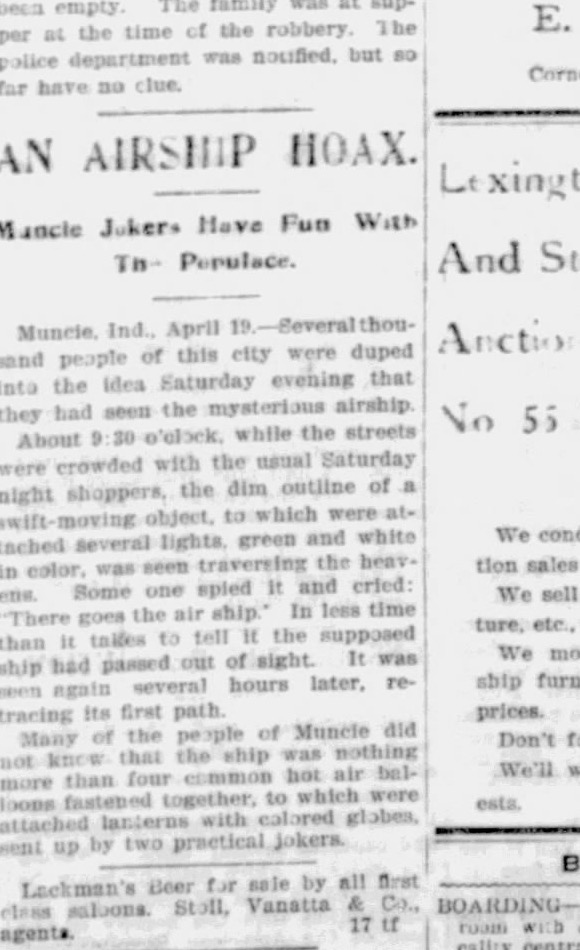
On April 19, 1897 — the same evening front section that carried the day’s tobacco sales and a cold-wave warning — the Daily Leader gave its readers “AN AIRSHIP HOAX,” a dispatch from Muncie, Indiana, where several thousand people had been “duped,” in the paper’s word, on a crowded Saturday night. A dim, swift-moving object hung with green and white lights crossed the heavens; someone cried out that there went the airship; it vanished and reappeared hours later, retracing its path. The machine turned out to be four common hot-air balloons tied together and hung with lanterns under colored globes, launched by two practical jokers — a debunking the Leader passed along with evident satisfaction.
Kentucky’s own sky was busy that month. Papers in Paducah carried airship items in mid-April; Owensboro and Hopkinsville papers were still running sightings and airship gossip into the second week of May. And the explanations traveled as fast as the sightings: by late April, Kentucky weeklies were reprinting the St. Louis Republic’s exposure of one celebrated “airship” as a manufactured fake — the aerial monster, readers learned, had been built in New York.
The airship you could buy a ticket to believe in
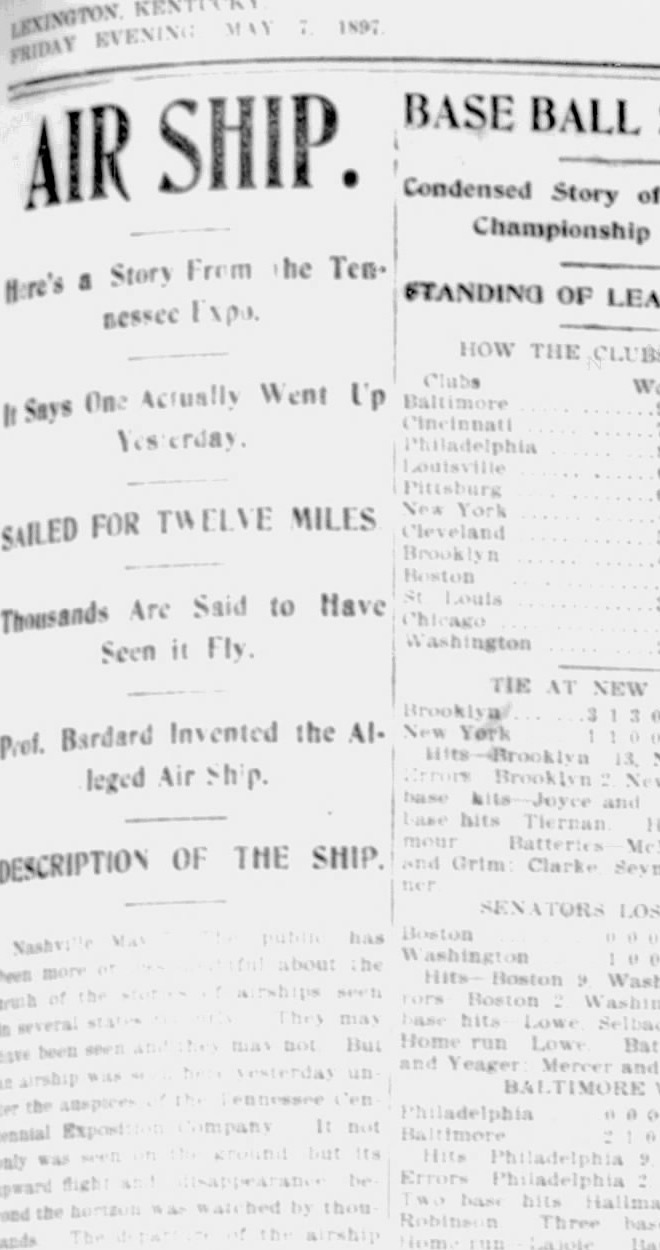
Then, on May 7, the Daily Leader printed the wave’s perfect Kentucky-adjacent ending. Under the headline “AIR SHIP.” and a stack of decks worthy of a moon landing — a story from the Tennessee Centennial Exposition in Nashville, which said one had actually gone up the day before, sailed for twelve miles, and been watched by thousands — the paper told the story of Professor A. W. Barnard, the director of physical culture at the Nashville YMCA, whom the Exposition company had contracted months earlier to build a real airship.
The Leader’s correspondent could not resist the framing, noting that the public had been “more or less doubtful” about the airships seen across several states — they may have been seen and they may not — but that this one had gone up under the official auspices of the Exposition itself, its ascent and disappearance over the horizon witnessed by a crowd. A barn-like structure had stood on a hill inside the fairgrounds for weeks; nobody had believed there was anything in it; nobody, the paper noted dryly, had even bothered to climb the hill and check. The great mystery of 1897, in other words, ended in Tennessee as a ticketed attraction with a gym teacher at the controls — equal parts aviation pioneer and exposition showman, which was about the most 1897 sentence the era ever produced.
What people were actually seeing
Historians who have worked through the 1897 wave generally land on a boring, human explanation: Venus low and bright that spring, fire balloons and pranksters like Muncie’s, kites with lanterns, outright newspaper inventions during a circulation war, and — most powerful of all — the simple fact that everyone had read that airships were real and coming. Inventors genuinely were racing toward powered flight; patents and prototypes were in the papers weekly; the airship was the most plausible miracle available. People didn’t see what they believed. They believed, and then they saw.
Which is why the 1897 flap reads so familiarly now. Swap the colored lanterns for drone lights and the Tennessee Exposition for a viral video, and Lexington’s April of 1897 — distant marvels reported credulously, local skeptics smirking, a hoax explained within the week, and everyone looking up anyway — could run in next week’s paper with the dates changed. The sky over Kentucky has always been a mirror. In 1897 it reflected a country that knew, correctly, that flight was coming, and simply couldn’t wait six more years for it to arrive.
Sources: The Daily Leader (Lexington), April 19 and May 7, 1897, and The Lexington Herald, April 24, 1897 (all public domain; page images via newspapers.com); contemporaneous airship coverage in the Paducah Sun (April 16–19, 1897), Owensboro Messenger (April 24–May 12, 1897), Hopkinsville Kentuckian (May 11, 1897) and Nelson County Record (April 23, 1897); on the wave generally, the standard accounts of the 1896–97 “mystery airship” episode in American press history.