Lexington History — the final piece of tonight’s overnight series from the original newspapers. The 1862 pages shown are in the public domain.
Dawn on Henry Clay’s lawn
At first light on Saturday, October 18, 1862, the war Lexington had spent a year reading about arrived on the most famous lawn in Kentucky. Camped on the grounds of Ashland — Henry Clay’s estate, barely a mile from the courthouse — were about 294 Union cavalrymen of the Third and Fourth Ohio. Coming at them through the gray were roughly 1,800 Confederate horsemen under Brigadier General John Hunt Morgan, who had planned the attack with particular confidence, because he was attacking his own hometown.
The fight was short and one-sided. Colonel W. C. P. Breckinridge’s dismounted troopers struck from the Richmond Road side while Colonel Basil Duke’s Second Kentucky Cavalry circled and opened on the camp from behind; caught between, the Ohioans broke. Four were killed and about 290 captured, two dozen of them wounded. Morgan, who made a habit of it, paroled the entire catch — signed paperwork promising they’d fight no more until exchanged — rode into town long enough to make the point, and was gone with his column down the Versailles Pike by afternoon. The Battle of Ashland, as the marker on Sycamore Road now calls it, had lasted about as long as breakfast.
What Louisville heard
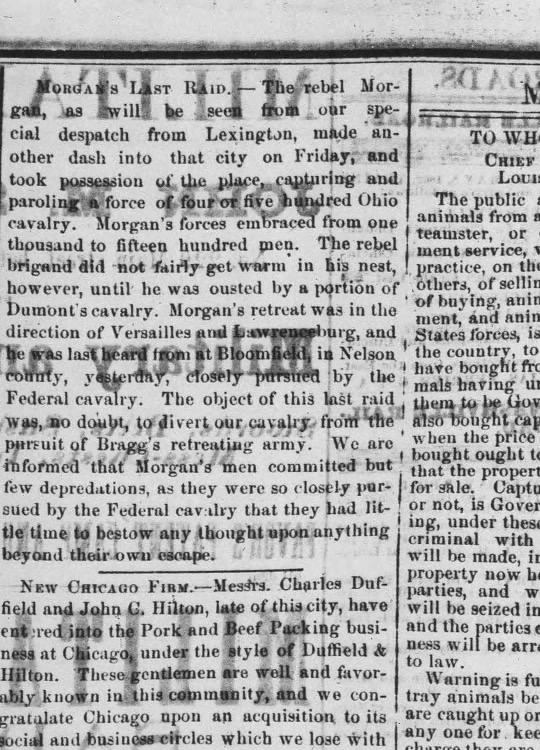
The Louisville Journal’s report two days later — printed at 3 a.m. Monday, in an edition whose adjacent column offered Henry rifle cartridges to “any of our Union friends” from the newspaper’s own office — is a perfect specimen of first-draft war news. Under “Morgan’s Last Raid,” it had the rebel raider capturing and paroling “four or five hundred” Ohio cavalry (inflated by nearly half), his force pegged anywhere from one thousand to fifteen hundred, and his men committing “but few depredations” — though the Journal, no friend of Morgan, credited the restraint to the Federal cavalry chasing him too closely for proper looting. The paper read the raid’s purpose correctly, though: a diversion to cover General Braxton Bragg’s army as it retreated from the state after the bloodbath at Perryville ten days earlier. The same column’s mail notice tells you what the autumn had been like — postal service to Lexington, Paris, Versailles and half the Bluegrass was only that morning being restored, “now that the greater portion of the State has fallen into the possession of the government troops,” after two months in which Kentucky had functionally been a Confederate state.
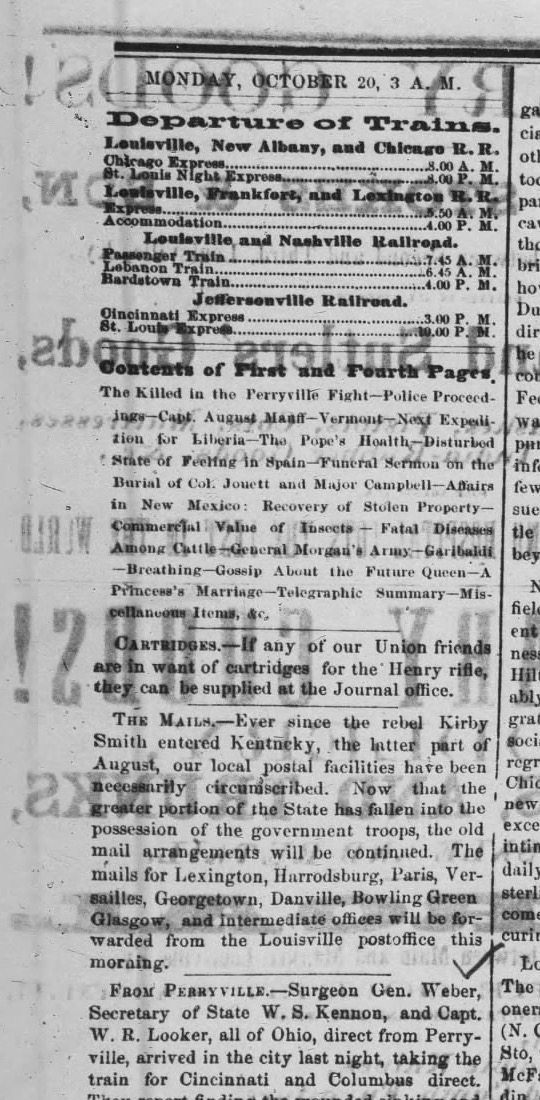
That is the context the Ashland fight sits in. The Confederate invasion of Kentucky — Kirby Smith’s occupation of Lexington from September 2, the installation of a Confederate state government at Frankfort that lasted one day, Bragg and Buell’s collision at Perryville on October 8 — was collapsing, and Morgan’s dash through his hometown was its rear guard: a last, theatrical Confederate flourish in a city the Confederacy would never hold again.
The hometown boy
Lexington’s relationship with Morgan was, and remains, complicated in ways the marker text doesn’t capture. He was the grandson of John Wesley Hunt, one of the first millionaires west of the Alleghenies, raised in the family mansion on Gratz Park that still bears both names — Hunt-Morgan House. Before the war he was a hemp manufacturer and militia captain; during it he became the “Thunderbolt of the Confederacy,” the beau ideal of the Lost Cause cavalier — and, less romantically, a raider whose commands stole horses on an industrial scale from the same Bluegrass farmers who toasted him, and whose great 1863 raid into Indiana and Ohio ended with most of his command captured. He did not survive the war: Federal troopers killed him in a garden in Greeneville, Tennessee, in September 1864. Lexington brought him home in 1868, to the Lexington Cemetery — the burial ground that exists, as tonight’s first story told, partly because the city’s churchyards had been overwhelmed in 1833.
And then Lexington spent a century arguing with his statue. The equestrian Morgan went up on the old courthouse lawn in 1911, at the high tide of Confederate memorialization — the same courthouse lawn where, nine years later, the troops would fire on the Lockett mob in tonight’s second story. (Generations of UK students knew the statue mainly for the joke that the sculptor had given Morgan’s famous mare, Black Bess, the anatomy of a stallion.) In 2018, after the national reckoning over Confederate monuments, the city moved Morgan and the nearby John C. Breckinridge statue from the courthouse grounds to the Lexington Cemetery — where Morgan now stands a short ride from King Solomon’s 1908 monument and Henry Clay’s column, in the one place in Lexington where all of the nineteenth century is permanently neighbors.
Closing the notebook
That makes seven stories since sundown, and they keep shaking hands with each other: the cholera that filled the burying grounds and the gravedigger who filled them properly; the captain from the Second Kentucky Infantry shot in a saloon and the memorial that carries his name; the courthouse lawn that hosted first a Confederate statue and then a volley against a lynch mob; the hotel that kept rising from its ashes until a developer finished what fire couldn’t; the opera house that burned and the one that didn’t; the madam whose legend ate her biography; the airship everyone saw six years before anyone flew. One city, one square mile, two centuries of newsprint — all of it sitting in the archives, waiting for somebody to read it.
The history desk is going to get some sleep. The bound volumes will still be there in the morning.
Sources: Louisville Daily Journal, Oct. 20, 1862 (public domain); Lexington History Museum, “Ashland Clash Makes Its Mark”; the Kentucky historical marker “Civil War Action at ‘Ashland’” and the Battle of Ashland memorial records; Wikipedia, “John Hunt Morgan” and “Lexington in the American Civil War”; American Battlefield Trust biographical materials; contemporary coverage of the 2018 statue relocations.