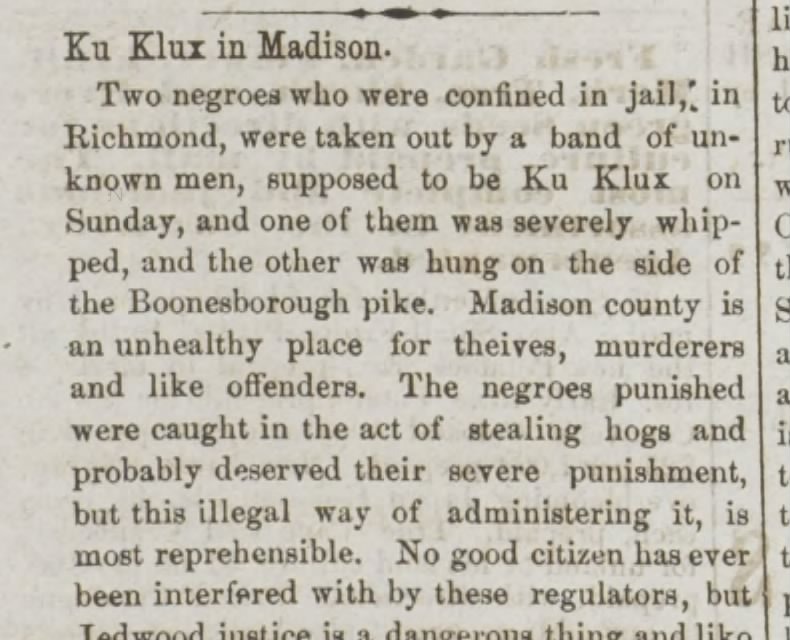
Between the summer of 1869 and the fall of 1870 — barely fifteen months — mobs in Madison County, Kentucky killed at least seven Black people. The county had a courthouse at Richmond, a college at Berea founded on the principle of racial equality, and, for that stretch, a Klan that rode more or less as it pleased.
The killings ran in a tight arc of geography and time. In July 1869, Charles Handerson was shot — and his wife killed with him. That October, George Rose was murdered near Kirkville. On November 4, a mob hanged Frank Searcy at Richmond. On December 12, a band of “unknown men” walked into the jail at Richmond, took two Black prisoners, hanged one and whipped the other. The next February they hanged a man named Sims near Kingston, and hanged and whipped Douglass Rodes in the same neighborhood. By September 1870 they had hanged Oliver Williams, and along the way shot Howard Gilbert. [1871 Memorial of the Colored Citizens of Frankfort, incidents in Madison County; Colored Conventions Project.]
Eight households, by a conservative count, in one county, in a little over a year.
The county kept its own
What is remarkable is not only that this happened, but that we can still read about it in the white newspapers — which generally preferred not to dwell on such things. The Kentucky Gazette in Lexington, no friend of Reconstruction, reported the December jail raid almost in passing: “Ku Klux in Madison. Two negroes who were [held] at Richmond were taken by unknown men, supposed” to be Klan. [Kentucky Gazette, Dec. 15, 1869.] Two months later it noted, just as flatly, that “the Ku-Klux in Madison… hung a man named Sims who lived near” Kingston. [Kentucky Gazette, Feb. 12, 1870.] By that February the paper was running a grim weekly tally — “From the Jail to the Tree. Two Victims in one Week” — and observing that the Klan was “dispatch[ing] their victims” so steadily “there will be few left in a short time, for the courts of Justice to administer upon.” [Kentucky Gazette, Feb. 23, 1870.]
The phrasing is worth sitting with. A conservative paper, hostile to Black political power, was reporting these deaths not as a scandal but as weather — a thing that simply happened in Madison County that season.
What the record kept, and what it lost
A century and a half later, almost none of it survives in the public memory of lynching. The Equal Justice Initiative’s accounting begins in 1877; the historical markers begin later. Everything above happened before the clock the modern reckoning runs by had started. [eji.org.]
Even the scholarship is uneven. George C. Wright’s Racial Violence in Kentucky, 1865–1940 — the most thorough catalog ever assembled — found three of these Madison victims and entered them in his inventory by name: George Rose, Frank Searcy, and Oliver Williams. [Wright, inventory #52, #53, and p.332.] The other four he never recorded at all. Charles Handerson, Robert Mershon, Douglass Rodes, Howard Gilbert: search the standard references and they are nowhere. [Cross-checked against Wright’s full-text index; no entry returned.] They survive in one place on earth — the 1871 petition that Black Kentuckians in Frankfort mailed to Congress, begging for a law to keep them alive.
Wright himself explained why the record is so thin. The Black newspapers that once covered Kentucky “have not been preserved,” he wrote, leaving historians “forced to rely on accounts published by contemporary whites.” [Wright, p.28.] The men of Madison County were killed in front of a press that mostly shrugged, and remembered — when they were remembered at all — by the people the press ignored.
The households
Read the Madison list closely and a particular cruelty surfaces: the violence did not stop at the targeted man. When the Klan shot Charles Handerson, the 1871 petitioners recorded, they killed his wife with him. These were household killings, in cabins along the creeks. [1871 Memorial.]
That is the part the word “lynching” can flatten. These were not, mostly, the courthouse-square spectacles of the 1890s. They were night raids on Black households in the river counties south and east of Lexington — a campaign to make Black life in Madison County ungovernable, and Black voting in it impossible, four days at a time.
The college on the hill
There is a particular irony in where this happened. Madison County was also home to Berea College — founded in 1855 by the abolitionist John G. Fee as a deliberately interracial school, and in these very years enrolling Black and white students in roughly equal numbers, the rare place in the South built on the idea that the races should learn side by side. It was no safe harbor: Berea, too, “came under attack for several years after the war.” [Wright, p.58.] The same county that tried, on one hill, to model what an integrated Kentucky might be was, in its hollows and along its creeks, hunting Black families out of their homes. Both were true of Madison County at once. Only one of them is much remembered.
Naming them
The petitioners of 1871 could not save their neighbors. The law they begged for did little; the killing in Madison ran on into 1870 and the terror in the Bluegrass into 1872 and beyond. What the six men in Frankfort could do was write the names down so they would not vanish entirely.
So, from Madison County, between 1869 and 1870:
Charles Handerson, and his wife. Howard Gilbert. George Rose. Frank Searcy. Two men taken from the Richmond jail. A man named Sims. Douglass Rodes. Oliver Williams.
Most of them are in no database and on no marker. They were here. It happened here. We are still counting.
Republishing: This is original Lexington Times reporting, licensed under Creative Commons CC BY-ND 4.0. You may republish this article, in full and unaltered, for free — including commercially — with credit to The Lexington Times and a link to the original.