🌎 Resumen en español · traducción automática
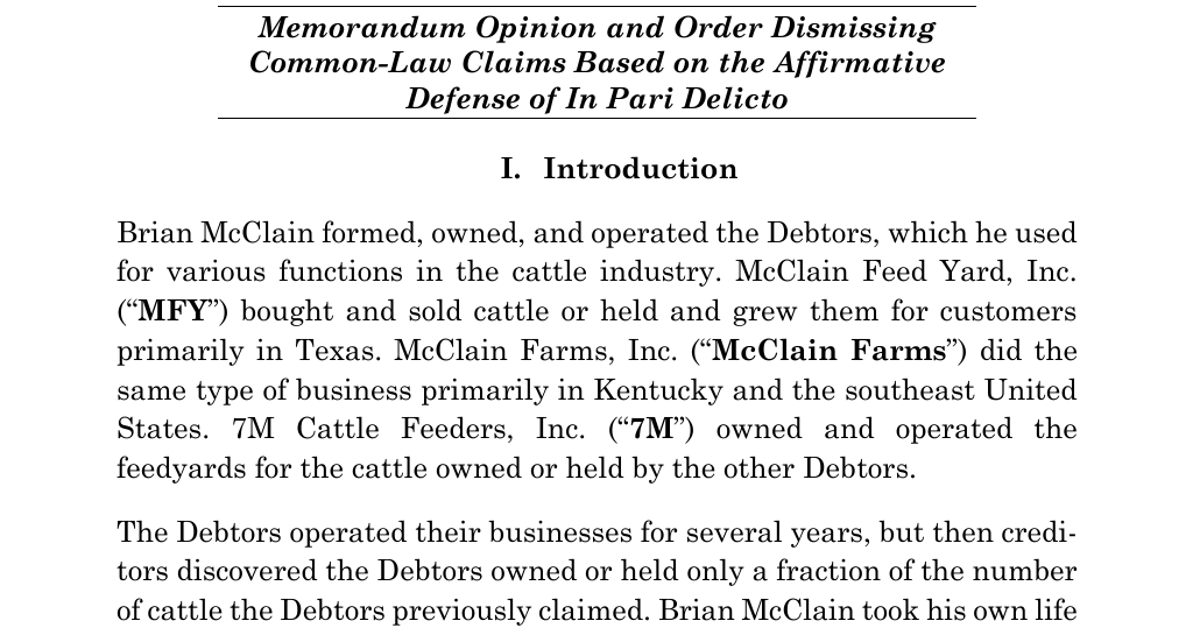
Un granjero de ganado de Benton, Kentucky, llamado Brian McClain, quien se suicidó en abril de 2023 después de que auditores descubrieran que casi 80,000 de sus reses nunca existieron, operaba un esquema Ponzi que movió 2,000 millones de dólares a través de las cuentas de sus empresas en cinco años. Un juez de quiebras desestimó la demanda principal del síndico de quiebras contra cuatro bancos utilizando la doctrina legal de "in pari delicto" (igualmente culpables), argumentando que como las empresas de McClain eran las demandantes originales y él era el responsable del fraude, el síndico hereda esa defensa al asumir los reclamos legales de las empresas quebradas. Esta decisión legal ha permitido que los bancos eviten responsabilidad en el litigio, a pesar de las acusaciones de que facilitaron el esquema fraudulento.
Traducción y resumen generados por IA a partir del artículo en inglés. Puede contener errores; consulte el texto original.
In February, we told you about the strangest 20-mile radius in Kentucky: a Benton cattle farmer named Brian McClain who died by suicide in April 2023 as auditors discovered that nearly 80,000 of his cattle never existed; a bankruptcy trustee who accused four banks of enabling a Ponzi scheme that moved $2 billion through the companies’ accounts in five years; a private investigator telling a 400,000-view podcast the money trail leads to a Mexican cartel; and, one county over, a gated riverfront mansion raided by federal agents in a crypto kidnapping-and-torture case. Read the original report here.
Five months later, the court fight has taken a turn almost nobody outside a bankruptcy courtroom would have predicted — and it’s wilder than fiction: the banks’ most effective defense so far is that Brian McClain was the mastermind. Here’s what the court records actually show.
Four words of Latin
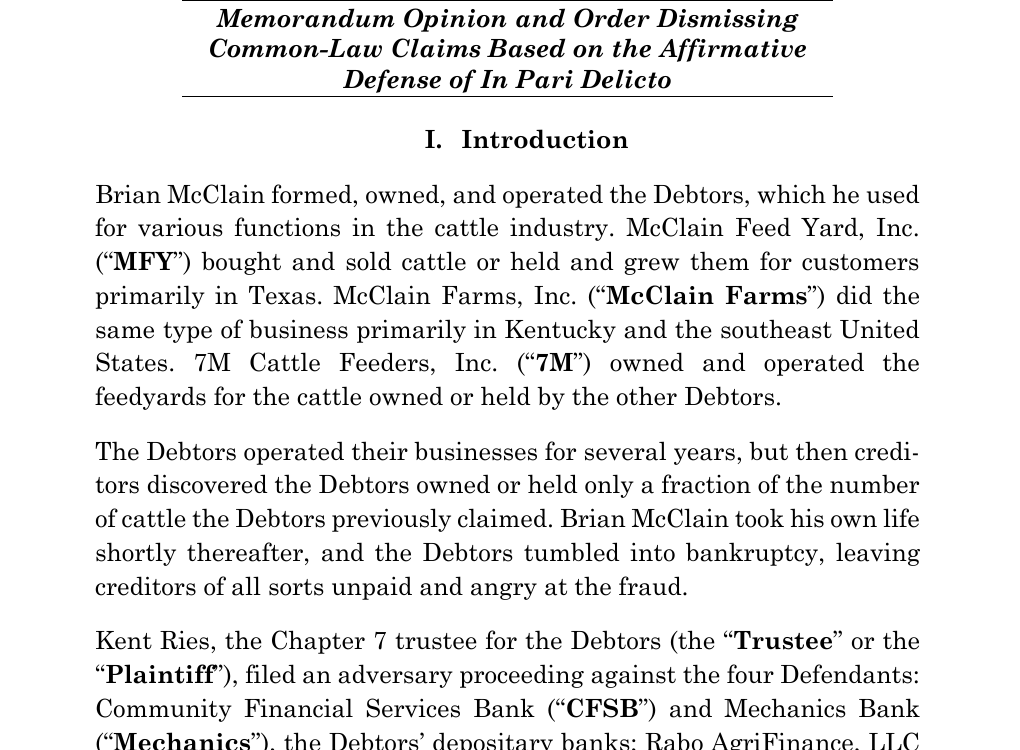
On March 27, 2026, U.S. Bankruptcy Judge Scott W. Everett in the Northern District of Texas — where McClain’s three companies filed Chapter 7 — dismissed the heart of trustee Kent Ries’s lawsuit against the four banks: Rabo AgriFinance (the primary lender), Community Financial Services Bank of Benton and Mechanics Bank (the deposit banks), and HTLF Bank.
The weapon was an equitable doctrine called in pari delicto — “equally at fault.” The idea, which traces back centuries in English and American law, is that courts won’t referee disputes between wrongdoers: if you and I rob a bank together, I can’t sue you for shorting me on the split.
Here’s the twist that decided the case. The trustee, Kent Ries, did nothing wrong — he was appointed after the collapse to recover money for the victims. But under Section 541 of the Bankruptcy Code, a trustee “steps into the shoes” of the bankrupt companies and inherits their legal claims exactly as they existed — including every defense that could have been raised against them. And the bankrupt companies were McClain’s companies. As Judge Everett put it:
“The Trustee’s Second Amended Complaint makes abundantly clear that while Brian McClain controlled the Debtors, they were at least equally at fault with the Defendants… because the Debtors masterminded and orchestrated the schemes while the Defendants participated in and helped the schemes in different ways.”
In other words: the more vividly the trustee described McClain’s fraud, the stronger the banks’ defense became. The court dismissed all six common-law counts — knowing participation in breach of fiduciary duty, breach of fiduciary duty, civil conspiracy, professional negligence, punitive damages, and money had and received — with prejudice, meaning they cannot be refiled. The judge noted that nine federal circuit courts of appeals, including the Fifth Circuit, have rejected the trustee’s counterarguments, and rejected the plea that innocent creditors would recover less: sympathy for creditors, he wrote, cannot give a trustee greater rights than the debtor had.
The opinion also crystallized, in a court ruling for the first time, how the scheme actually died: Rabo’s senior executives in Europe shut down the loan renewals and increases that Rabo’s U.S. employees had, in the complaint’s words, previously “rubberstamped.” That triggered the cattle inspection that found the companies had roughly 8,000 cattle when they claimed 80,000.
Then came the quiet part: three more orders
The in pari delicto ruling got a few paragraphs in the trade press. What went essentially unreported is that Judge Everett followed it with a series of orders through the spring that dismantled most of what remained of the trustee’s case — at least for now:
- March 27 (Doc. 405) — all six common-law counts vs. all four banks, dismissed with prejudice (in pari delicto).
- April 8 (Doc. 412) — fraudulent-transfer claims vs. CFSB: constructive claims dead with prejudice; actual-fraud and insider theories dismissed but repleadable.
- April 10 (Doc. 413) — preference and fraudulent-transfer claims vs. Mechanics Bank: same pattern; the court found the trustee had not adequately pleaded that Mechanics was an “insider.”
- May 1 (Doc. 425) — fraudulent-transfer and preference claims vs. HTLF: mostly dismissed but repleadable; claims over repayment of cattle-investment principal dead with prejudice.
- Still pending — the biggest one: Rabo’s motion to dismiss the avoidance claims against it is still awaiting a ruling.
The recurring logic in the April and May orders is as cold as it is simple: paying back a loan, dollar for dollar, is by definition an exchange of “reasonably equivalent value,” so it can’t be a constructive fraudulent transfer — even if the money used to repay the loan came out of a Ponzi scheme. In each order the judge told the trustee not to replead anything until the court rules on the remaining motions, with Rabo’s at the end of the line. In late March the court also transferred the consolidated case to the Lubbock Division, where it now sits.
The trustee’s counterpunch: Rabo wasn’t an accomplice — it was running the place
On April 10, the trustee filed a motion asking Judge Everett to reconsider the in pari delicto ruling — or at least let him amend his complaint one more time. The motion concedes the legal framework but attacks its central premise as applied to Rabo.
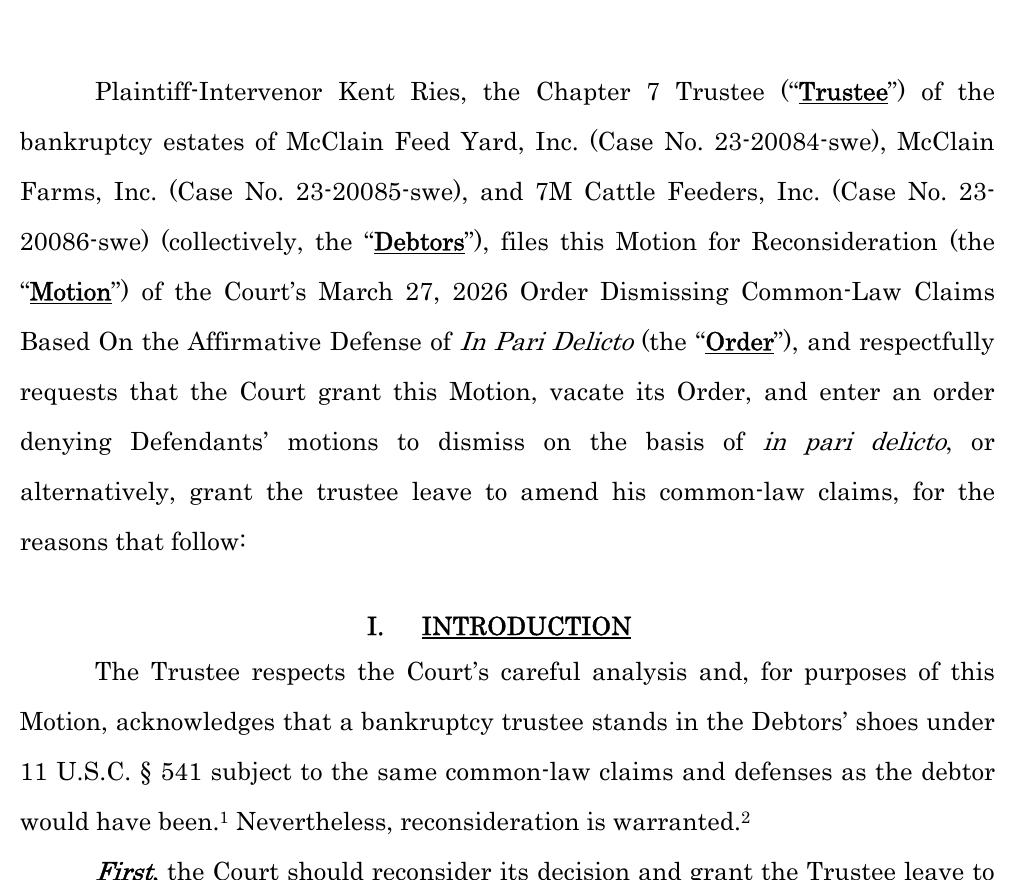
In pari delicto has recognized exceptions, and the trustee is aiming for one of them: insiders can’t use it. A company’s own insiders — officers, directors, controlling persons — can’t escape liability to the company by pointing at the company’s own misconduct, because that misconduct was theirs. The trustee’s brief argues Rabo effectively became an insider of the McClain companies, alleging the bank “exerted excessive control over the Debtors,” including:
“…regularly commanding some of the Debtors’ cash transactions on a near daily basis and extracting the DACAs [deposit account control agreements] and broad releases and waivers of claims preceding McClain’s removal.”
That “removal” is the fulcrum. Days before the bankruptcy, Rabo executed a forbearance agreement that required the companies to hand control to a “chief restructuring officer” of Rabo’s choosing — a takeover the trustee’s complaint describes, and Judge Everett’s own opinion recounts, as the “coronation” of a hand-picked officer. If the entity invoking “the debtors were the wrongdoers” was itself controlling the debtors, the trustee argues, the doctrine collapses on itself.
The banks filed oppositions on May 1; the trustee replied May 8; HTLF joined the fight with a filing June 3. A hearing was held in the consolidated case on June 24 — the docket doesn’t yet reflect what was argued or decided — and as of this writing, no ruling on reconsideration has appeared. The trustee has already stated in his brief that he is preserving the Section 541 issue for appeal. This is not over.
The cartel history is now in a federal complaint — not just a podcast
When we wrote in February, the claim that this saga brushes up against cartel money came mostly from Jon Griggs, the private investigator whose two appearances on the Borderland podcast pulled 400,000-plus views. We were careful then to flag what was verified and what wasn’t. Here’s what’s changed: the trustee’s operative complaint — a federal court filing, not a YouTube interview — devotes pages to Rabo’s corporate history with laundered money.
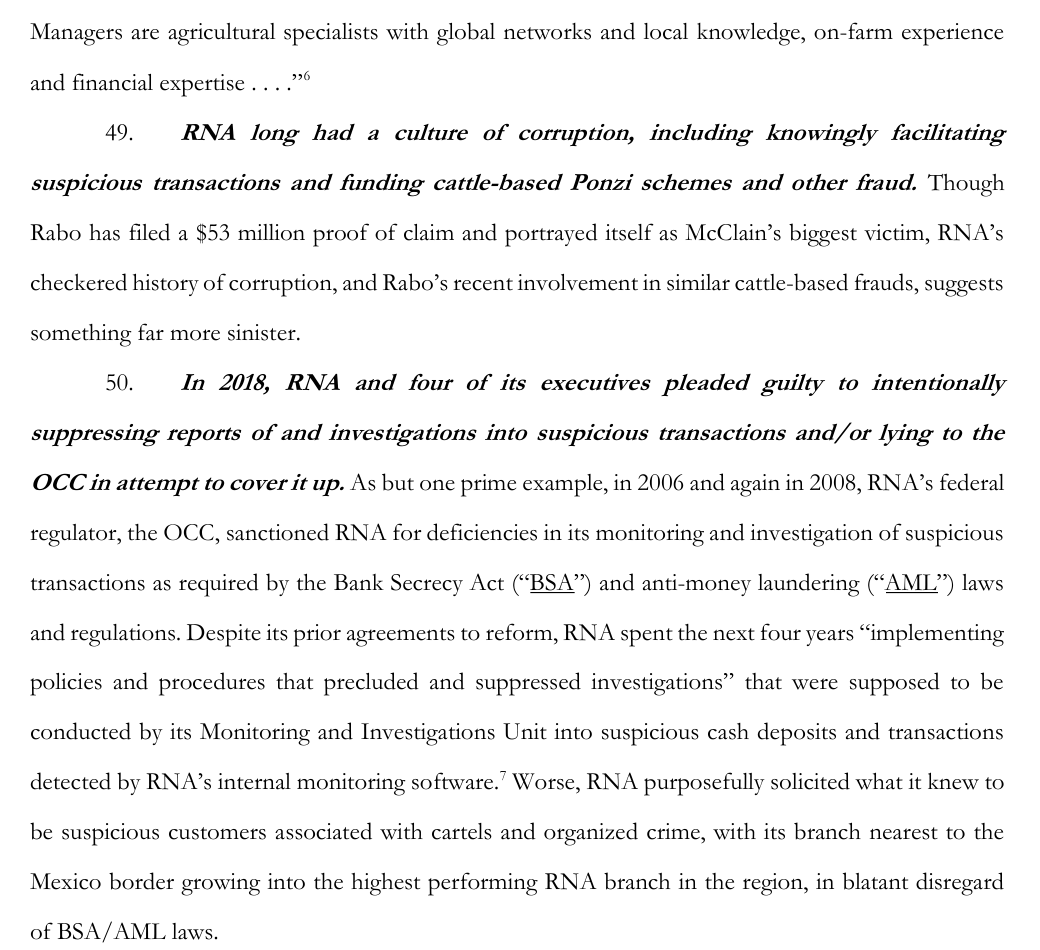
The complaint recounts — citing the federal criminal case — that in 2018, Rabobank N.A. pleaded guilty to suppressing investigations into suspicious transactions and was “required to forfeit approximately $369 million dollars in suspected cartel and other criminal proceeds,” that the bank “purposefully solicited what it knew to be suspicious customers associated with cartels and organized crime,” and that its branch nearest the Mexican border grew into its highest-performing branch in the region. It alleges the corruption ran to the CEO, general counsel and chief compliance officer, and that the executive who raised concerns was fired.
The complaint then stacks up a pattern the February podcast never mentioned:
- In the same Texas bankruptcy court, Rabo was previously accused of conspiring with another cattle-operation debtor to defraud lenders (In re Waggoner Cattle) — and the trustee says the allegations there involved “some of the same individuals involved in managing the Debtors’ loans, including Michelle Stockett, the collateral inspector who failed to notice tens of thousands of cows were missing in the first three or four years she inspected the Debtors’ operations.” Rabo settled that case after losing its early attempts to dismiss it.
- Rabo was a lender to an affiliate of the perpetrator of the 2021 “ghost cattle” fraud against Tyson Foods — a separate $200 million scheme built, like this one, on cattle that didn’t exist.
- Rabo “presently stands accused in California state court of facilitating another cattle-based Ponzi-scheme of the exact same type as in this case,” per the complaint.
None of that establishes that cartel money moved through Marshall County, Kentucky — and it’s worth saying plainly that no criminal charges have been filed against anyone in the McClain matter, and the banks deny wrongdoing. Rabo, for its part, has filed a $53 million proof of claim in the bankruptcy, styling itself as McClain’s biggest victim. The trustee’s response, in one of the more quotable lines you’ll find in a bankruptcy pleading: Rabo’s actions “shout ‘culpability’ loud enough to shatter windows.”
$9.65 million in checks to one counterparty
One exhibit to the trustee’s complaint deserves its own moment. Exhibit C is a table of 28 checks written from McClain Farms’ account at Community Financial Services Bank — the Benton bank — to Terry “Bo” Robinson, his wife Becky, and their partnership 2B Farms, between February 2018 and January 2022. The total: $9,653,108.15, including single checks over $1.1 million, $1.17 million and $1.35 million in a single week of August 2021.
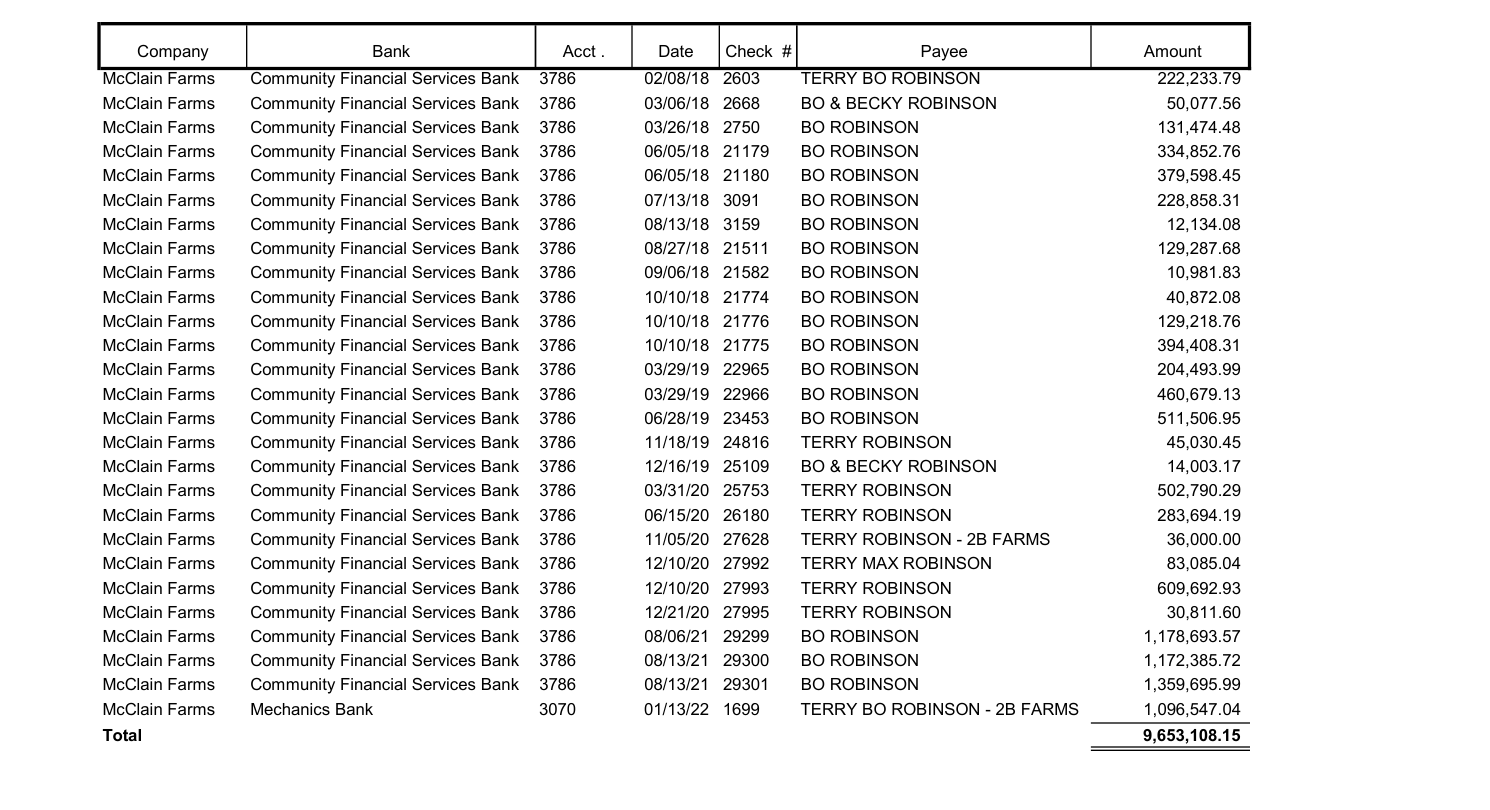
The Robinsons and 2B Farms — a Texas general partnership — are not accused of a crime; their operation is in its own bankruptcy (jointly administered in the same consolidated case), HTLF was their depositary bank, and they are themselves suing the banks as third-party plaintiffs. The exhibit matters because it shows, in black and white, the kind of enormous circular cash flows between McClain’s accounts and his biggest counterparties that the trustee says the deposit banks watched for years. The trustee’s broader allegation: intercompany transfers “totaled in the tens of millions per month and $2 billion in 5 years.”
The victims’ own lawsuits are very much alive
Here’s the crucial distinction that most of the coverage has missed. In pari delicto killed the trustee’s common-law claims because the trustee inherits the con man’s legal shoes. The victims never wore those shoes. Farmers, investors and lenders who lost money have their own direct suits pending against the same banks:
- The consolidated Texas case already includes direct claims by AgTexas Farm Credit Services, Thorlakson Diamond T Feeders and dozens of intervening farmers, trusts and cattle companies. The banks’ motions to dismiss those claims were argued February 17 and remain under advisement — a ruling could land any day.
- A Kentucky class action. In July 2025, the Paducah-based Bryant Law Center, with Strauss Troy and William F. McMurry & Associates, filed a class action in Graves County Circuit Court on behalf of Kentucky investors against CFSB, Rabo and Mechanics — alleging aiding and abetting breach of fiduciary duty, theft by deception, gross negligence, securities violations and civil conspiracy under state law.
So the scoreboard, plainly: the estate’s tort claims are dead; the estate’s clawback claims are wounded and waiting on the Rabo ruling; and the victims’ direct claims — in two states — are alive and unresolved.
Meanwhile, at the mansion
The other pole of our February story — John Woeltz, the Paducah-born “crypto king of Kentucky” charged in Manhattan with kidnapping and torturing an Italian man for his Bitcoin password, whose gated Smithland estate was raided by ATF, NYPD and Kentucky State Police — remains in pretrial limbo. Woeltz and co-defendant William Duplessie have been free since July 2025 on $1 million bail each, with passports surrendered, ankle monitors on, and home confinement ordered. Manhattan prosecutors have since alleged a Woeltz assistant was involved in the episode, two NYPD detectives were placed on leave over their moonlighting connections to the case, and defense lawyers have released photos they say show the accuser moving freely during his 17 days in the townhouse. No trial date has been made public, and we found no public forfeiture filing against the Smithland property.
What to watch next
The Rabo ruling. Every other order teed this up as the finale: the court told the trustee he can’t replead anything until it rules on Rabo’s motion to dismiss the remaining claims against it — the preference and fraudulent-transfer counts aimed at the lender that says it is owed $53 million.
The reconsideration decision. If Judge Everett grants leave to amend on the insider theory, the biggest claims come back from the dead. If he denies it, expect an appeal — the trustee has said so in writing.
The transcripts. The 157-page transcript of the January 21 dismissal argument became public June 2, and the February 17 argument over the victims’ direct claims unsealed June 15. We’ve pulled the dockets; we’ll be reading.
The third episode. Jon Griggs has said more Borderland episodes are coming and has publicly asked for volunteers with financial-forensics and OSINT skills to help work through some 2,000 payout records. Whatever he surfaces next, the paper trail above — the court-filed one — is now big enough to check him against.
The Lexington Times will continue following the case. Read our original February report, “Ghost Cattle, Cartel Cash, and a Crypto Torture Mansion — All Within 20 Miles of Each Other in Kentucky.”
Sources
- Memorandum Opinion and Order Dismissing Common-Law Claims Based on In Pari Delicto, Adv. No. 24-2007-swe, Doc. 405 (Bankr. N.D. Tex. Mar. 27, 2026)
- Trustee’s Second Amended Adversary Complaint and Exhibits, Adv. No. 25-2005, Doc. 48 (July 2, 2025)
- Order dismissing claims against CFSB, Adv. No. 24-2007, Doc. 412 (Apr. 8, 2026)
- Order dismissing claims against Mechanics Bank, Adv. No. 24-2007, Doc. 413 (Apr. 10, 2026)
- Order dismissing claims against HTLF, Adv. No. 24-2007, Doc. 425 (May 1, 2026)
- Trustee’s Motion for Reconsideration and Brief, Adv. No. 24-2007, Docs. 414–415 (Apr. 10, 2026)
- Consolidated adversary docket, AgTexas v. Rabo AgriFinance, 24-02007 (CourtListener/RECAP)
- WPSD Local 6, “Trustee in ‘ghost cattle’ suit files motion to reconsider” (Apr. 2026)
- WPSD Local 6, “Class action lawsuit filed against banks in alleged ‘ghost cattle’ scheme” (July 10, 2025)
- ABC7 New York, bail ruling for Woeltz and Duplessie (July 23, 2025)
- United States v. Rabobank, N.A., No. 18-CR-0614-JM (S.D. Cal. 2018), as cited in trustee’s complaint ¶¶ 50–51
- Borderland podcast (IRONCLAD), Kentucky episodes (Apr. 2025, Jan. 2026)
This report was drafted with AI assistance (Claude Fable 5) and finalized for publication by The Lexington Times. It is grounded in the federal court filings cited inline — pulled from the consolidated adversary docket (Bankr. N.D. Tex., Adv. No. 24-2007) via CourtListener/RECAP on July 4, 2026 — and all quotations were verified against the original documents. Document images are excerpts of public federal court filings.