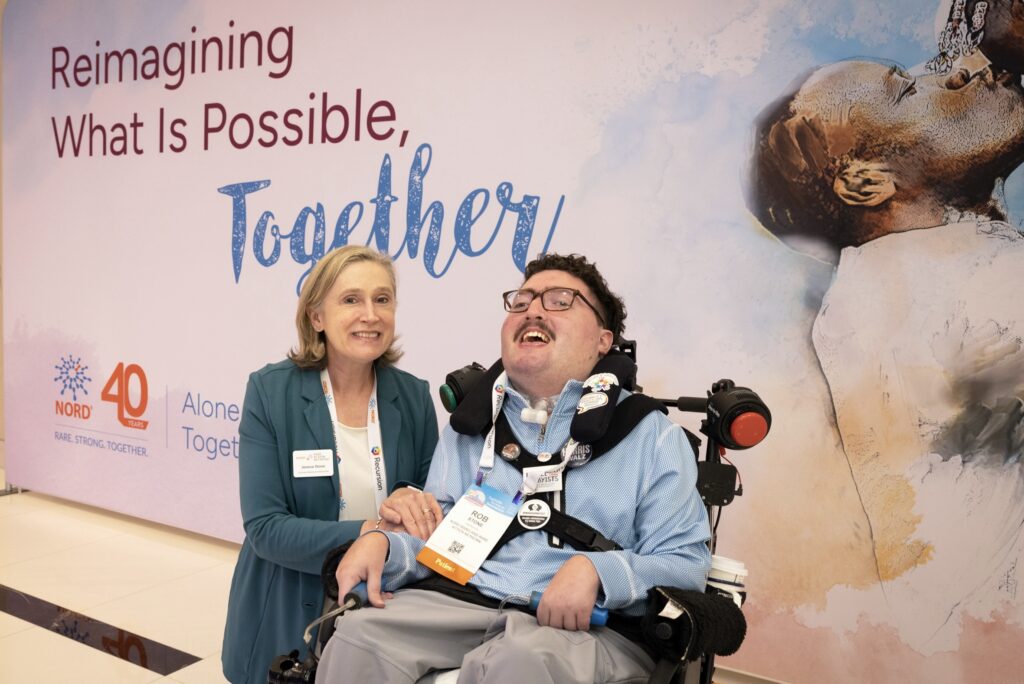
When Rob Stone finished high school in Bethesda, Maryland, in 2018, he was asked to identify three goals for his life. Stone loves art and baseball. He’s cheerful, sports a cheeky mustache, and he’s always up for an adventure.
Stone has a rare genetic movement disorder, dystonia-parkinsonism, that limits his mobility and speech. Setting specific goals would help him construct the life he wanted, and help his family identify the services he would need to live it to the fullest.
His parents suggested goals like “going on lots of walks” or “visiting state parks.” Stone just looked at them like they were ridiculous, said his mom, Jeneva Stone.
“We eventually discovered, through the right series of questions, that Robert wanted to protest,” she said. He’d watched disabled protesters dragged out of their wheelchairs from then-Senate Majority Leader Mitch McConnell’s office at the U.S. Capitol the year before, as they demanded the preservation of the Affordable Care Act.
Now 29, Rob has been a fixture on Capitol Hill and at the Maryland State House ever since, advocating alongside his parents for disability rights and healthcare. Earlier this year, he joined with other advocates to lobby the state legislature not to cut funding for services that help him and others live in their communities.
They weren’t able to prevent the cuts, but they did succeed in limiting them.
Disability advocates around the country are fighting a surge of federal and state actions that have eroded protections meant to keep people with disabilities living and working in their communities, rather than in institutions.
The federal government has walked away from decades-old requirements that states deliver disability services to people where they live. At the same time, state leaders, citing budget shortfalls, have rolled back community services the feds don’t require them to fund.
“It’s really hard,” said Rob Gorski, an Ohio father of three sons with autism who runs a popular social media account called TheAutismDad. “You try to wrap your head around one thing, and by the time you even figure out a path forward from there, they’ve thrown more stuff at you.”
In Maryland, state lawmakers were weighing cuts to Medicaid, the joint federal-state program that covers much of Rob’s care, which he receives at home. The federal government will be reducing its share of Medicaid funding as part of the One Big Beautiful Bill Act, the broad tax and spending measure President Donald Trump signed last summer.
Maryland ended up cutting $126 million from the agency that administers Medicaid for people with developmental disabilities — but that was less than the $150 million reduction that Democratic Gov. Wes Moore originally proposed. The final budget also scrapped a proposed cap on how much state funding a person in the program could receive per year.
“Medicaid itself isn’t just a budget line item,” Jeneva said. “It’s the mechanism through which the federal government ensures that people with disabilities have the civil right to live in their communities.”
Other threats to community-based disability services have emerged in Washington, D.C., and across the nation.
In June, the U.S. Department of Justice issued an opinion memo that says states don’t have to fund in-home or community-based services for people with disabilities who don’t want to live in institutions. The memo is a significant reinterpretation of federal law and represents a shift away from decades of civil rights protection.
The memo doesn’t change federal law, but it does signal a new focus for the DOJ, which is the primary enforcer of disability rights. Without enforcement, advocates worry, the civil rights protections they rely on could become moot.
In July, the DOJ published another notice saying it would no longer enforce its longstanding guidance on how to implement a landmark U.S. Supreme Court decision, Olmstead v. L.C., that requires public entities to provide community-based services, rather than institutional care, to people with disabilities whenever possible.
The federal spending reductions in the One Big Beautiful Bill Act are likely to spur more cash-strapped states to cut home- and community-based services, since the federal Medicaid law only requires them to provide institutional care. More than half a dozen states have already moved to limit such services for people with disabilities, according to an analysis of state actions by researchers at George Washington University.
And at least three states are suing to dismantle a section of disability law that requires states to provide community-based services.
Defenders of the changes say they will allow states to refocus their limited dollars on people with the most serious medical needs.
New Medicaid work requirements in the Trump law, which are expected to drop between 3 million and 7 million people from the rolls, “will free up more state funding for (home- and community-based services) recipients,” said Rachel Barkley, director of the Able Americans disability policy think tank, which is housed inside the conservative National Center for Public Policy Research.
But Jeneva Stone says the cuts in Maryland threaten her son’s ability to get the nursing and other services he needs to be able to live at home. She worries families like hers will be the first to face forced institutionalization.
“More and more burden falls on family caregivers to fill in the gaps, and that leads to unsustainable economic situations for families,” she said. “Once your job situation falls apart, your savings are gone, you’re faced with this ugly choice: I believe strongly in my son’s civil right to stay in his community, but I can’t keep a roof over his head.”
Everything feels uncertain, she said, as longstanding protections seem to be dissolving for her son and others like him.
“They’re happy, they’re living great lives,” she said. “Are they medically complicated? Yeah. But do they deserve to spend the rest of their lives lying in a bed in a facility just because it’s easier to care for them in a congregate setting?”
‘That’s what people want’
In the middle of the 20th century, disabled activists and their family members demanded an end to systemic abuses suffered by many of the hundreds of thousands of disabled people who were hidden away in sprawling state institutions around the country.
In the following decades, presidents and lawmakers of both parties championed a national shift away from segregating disabled people in huge facilities and toward the provision of services — such as home health nurses, physical therapy or adaptive tools — that would enable them to live at home or in their communities.
The two most consequential landmark federal disability rights laws were signed by Republican presidents: Richard Nixon signed the Rehabilitation Act in 1973, and George H.W. Bush signed the Americans with Disabilities Act in 1990. Then, in its 1999 Olmstead ruling, the U.S. Supreme Court ruled that the unjustified institutionalization of people with disabilities was a form of discrimination.
“For decades we have very intentionally been shifting resources away from institutional care and into the community, because that’s what people want, and it’s more cost effective,” said Alison Barkoff, a health law and policy professor and director of the Hirsh Health Law & Policy Program at George Washington University.
“We can serve, generally, three people in the community for every one person in an institution. And it leads to better outcomes.”
More than 8 million Medicaid users receive such home- and community-based services across the country, while 1.5 million get services in institutions, such as nursing homes. Federal law requires state Medicaid programs to provide medical care and other support for people with disabilities.
People who live in institutions cost Medicaid an average of $54,462 per year, compared with $17,298 for people who get home and community services, according to the most recent Medicaid data.
State investments in home- and community-based services often result in short-term spending increases, but over time lead to long-term cost savings and a reduction in institutional spending, according to research from Brandeis University’s Community Living Policy Center.
The national shift to community-based services has been overwhelmingly popular. About 82% of people who receive community-based services prefer to live at home rather than in an institution, according to the most recent survey by the Medicaid and CHIP Payment and Access Commission.
That’s why, said Barkoff, “it is incredibly shocking, the approach that this administration is taking to something that has been so bipartisan and so much a part of American culture for decades.”
Some Republican-led states now want courts to adopt the Trump administration’s new interpretation of the Olmstead decision. Texas has already used the June DOJ memo in its lawsuit challenging federal requirements to provide community-based services. Florida also has used the memo as part of its appeal of a case involving medically complex children who were forced into nursing homes because the state refused to pay for in-home services.
Conservative state leaders say the federal government shouldn’t dictate how states offer support for people with disabilities, and argue that nursing shortages and other issues make it too difficult for states to care for some people outside of institutions.
Left behind
Barkley of Able Americans supports the shift away from institutionalization, but she says there should be more public investment in group homes or smaller facilities that can provide 24/7 oversight for people with more complex needs who can’t live safely at home.
“Unfortunately, it’s only when somebody with a serious mental illness hits the criminal justice system that they’re able to receive care,” she said. “And so for this sliver of the serious mental illness population, this movement has left them behind.”
VOR, a national disability rights nonprofit that supports “a full continuum of care options” for people with disabilities, argues that overly aggressive enforcement of the Olmstead decision and related federal law has, in some cases, resulted in people with disabilities being moved into community settings without adequate support. That broad-strokes application has contributed to poor outcomes, including homelessness, for some people.
The DOJ memo and other federal actions reducing community care have been driven in part by the Trump administration’s push to address homelessness, said Barkoff. Trump issued an executive order last July giving states a green light to commit people experiencing homelessness to treatment centers or hospitals, whether they want to go or not.
“They have created this narrative that Olmstead created this problem” of not enough beds for people who need higher levels of care, said Barkoff. But without Olmstead, “there was just a hollow promise to close institutions,” she said.
“What Olmstead did was create a tool to require states to follow through on that commitment.”
Gorski said it’s been more apparent this year than ever that there are people and families, particularly those with complex care needs, who feel that the shift away from institutional care hasn’t helped them.
Recent efforts by the Trump administration to roll back protections are “exploiting where we’ve failed to ensure that we’re taking care of our own people,” he said. “Everyone in this community should feel seen and heard and like they have a place at the table.”
But even VOR warned in a June statement that the DOJ memo “substantially weakens” protections and federal pressure on states to fund the community-based services many people with intellectual or developmental disabilities depend on.
States on their own
In June, Republican lawmakers in Ohio swiftly backtracked on a proposal that would have barred Medicaid recipients’ family members from being paid as caregivers. They pulled the controversial portion of the bill after backlash from residents who said it would hurt people with developmental disabilities whose caregivers are often relatives whose caregiving duties prevent them from taking other jobs.
They’re happy, they’re living great lives. Are they medically complicated? Yeah. But do they deserve to spend the rest of their lives lying in a bed in a facility just because it’s easier to care for them in a congregate setting?
– Jeneva Stone, Maryland mother of a son with complex medical needs
Some states have recently expanded home and community-based services, including Georgia, Illinois, Ohio and Wyoming, according to George Washington University’s analysis. Others, including California, Idaho, Indiana, Maryland, Minnesota and Nebraska, have limited services.
Some, like Kansas and Virginia, have done both.
Ultimately, as the feds back away from enforcing civil rights protections, states are left to figure out how to offer services for people with disabilities in a way that balances civil rights with budget realities.
“At this point it’s kind of a state-by-state effort,” said Illinois state Sen. Julie Morrison, a Democrat who sponsored a bill this year, now law, that turned Illinois’s state disability commission into a cabinet-level agency.
“But at the end of the day we are obligated, morally I believe, to make sure we are taking care of people who need these services and who want to live in an independent environment.”
Rob Stone and his parents plan to continue meeting with state legislators in Maryland to push back against deeper cuts to services that help him remain with his family. His mother said she’s been doing a lot of explaining to lawmakers about how civil rights for people with disabilities fit into existing law.
“There’s a tremendous need for advocates to educate legislators at the state level about this because they’ve never had to think about these things before,” she said.
“It’s always been something the federal government takes care of.”
Stateline reporter Anna Claire Vollers can be reached at [email protected].
This story was originally produced by Stateline, which is part of States Newsroom, a nonprofit news network which includes Kentucky Lantern, and is supported by grants and a coalition of donors as a 501c(3) public charity.