🌎 Resumen en español · traducción automática
Un conflicto sobre 500 acres de tierra agrícola en el condado de Mercer, Kentucky, se intensificó cuando Brian Luftman, inversionista detrás de una propuesta de centro de datos, aparentemente amenazó con publicar una foto de arresto de Diane Floyd, crítica del proyecto, en un grupo de Facebook de 60,000 miembros. Floyd publicó capturas de pantalla del intercambio en redes sociales, generando controversia viral alrededor de la propuesta del centro de datos y el bar de bourbon Never Say Die Bourbon de Luftman en el centro de Lexington. El condado de Mercer tiene programada una votación de moratoria para el lunes mientras continúa el debate sobre este desarrollo.
Traducción y resumen generados por IA a partir del artículo en inglés. Puede contener errores; consulte el texto original.
A fight over 500 acres of Mercer County farmland has produced protests in matching blue T-shirts, a tiny city weighing whether to double its own footprint, a moratorium vote scheduled for Monday — and, as of this weekend, a viral set of screenshots in which the project’s most visible backer appears to ask a critic whether he should post her mugshot to a 60,000-member Lexington Facebook group.
If you missed the saga, here is the whole thing, from the beginning.
What happened this week
On Thursday night, Diane Floyd — a Mercer County resident who has spent the summer posting critically about a proposed data center near Shaker Village — published screenshots of a Facebook Messenger exchange, on her own profile and in the “No Kentucky Data Centers” group. She wrote that after she posted about the project in public groups, this “was the response I received.”
The screenshots appear to show a message from the personal account of Brian Luftman — the Lexington farmland investor whose firm is behind the data center proposal — reading, in full: “Should I post this on Lexington foodies?” Attached were two images: an arrest-records search form filled in with Floyd’s name, and a booking photo from arrests.org, a commercial mugshot site, showing a 2023 arrest record with “Arresting Agency: MERCER COUNTY.”
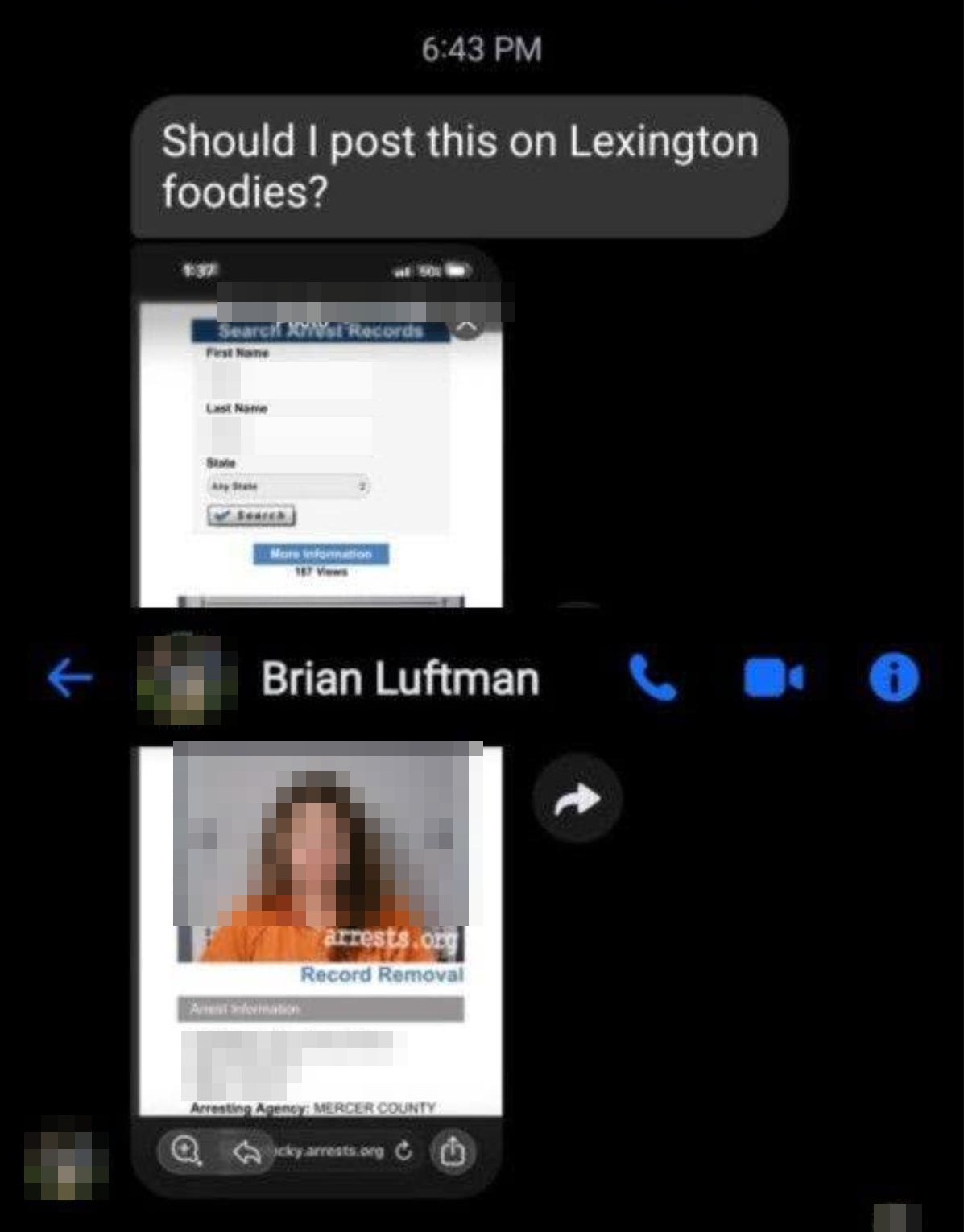
“Lexington Foodies” is one of the largest community groups on Kentucky Facebook — the kind of audience where a restaurant-adjacent business lives or dies. Floyd had been posting there and elsewhere about Luftman’s newest venture: Never Say Die Bourbon’s forthcoming distillery-pub in downtown Lexington. The implied proposition, as Floyd and tens of thousands of readers took it: keep talking about my bar, and your worst night becomes content.
The reply that went viral
Floyd answered the message directly, then published the whole exchange. “Yes. I know that photograph exists,” she wrote. “That photograph represents fear, humiliation, heartbreak, and one of the darkest experiences of my life. You may see it as ammunition. I see it as something I survived.”
“If your goal was to intimidate me into silence,” she continued, “you badly miscalculated. You didn’t find my weakness, Brian. You reminded me why I refuse to be bullied.”

By Friday morning, Lexington coffee-shop owner and former congressional candidate Andrew Cooperrider had shared the screenshots with his own summary of the zoning fight; his post alone has drawn more than 1,100 reactions, roughly 330 comments and nearly 500 shares as of Sunday. Floyd’s original posts have been shared across Lexington and Mercer County groups. No traditional news outlet has yet reported on the exchange.
The Times has not independently verified the messages beyond the screenshots Floyd published; Messenger conversations are end-to-end encrypted and visible only to their participants. Luftman has not publicly responded to the screenshots as of publication.
Who is Brian Luftman?
Luftman is a Lexington-based investor, a former Chicago Mercantile Exchange trader who founded American Farm Investors, a firm that buys Kentucky farmland and sells shares of it to investors. He is also a co-founder — with Lexington attorney Pat Madden and British partners — of Never Say Die Bourbon, a brand built around the story of a Kentucky-born racehorse that won the 1954 Epsom Derby.
He has been the proposed data center’s most visible local advocate, speaking in favor at public meetings. “If this was happening in my county, I would support it even if it was in my backyard,” he told a Mercer County crowd in June, per LEX18.
The project: a hyperscale campus two miles from Shaker Village
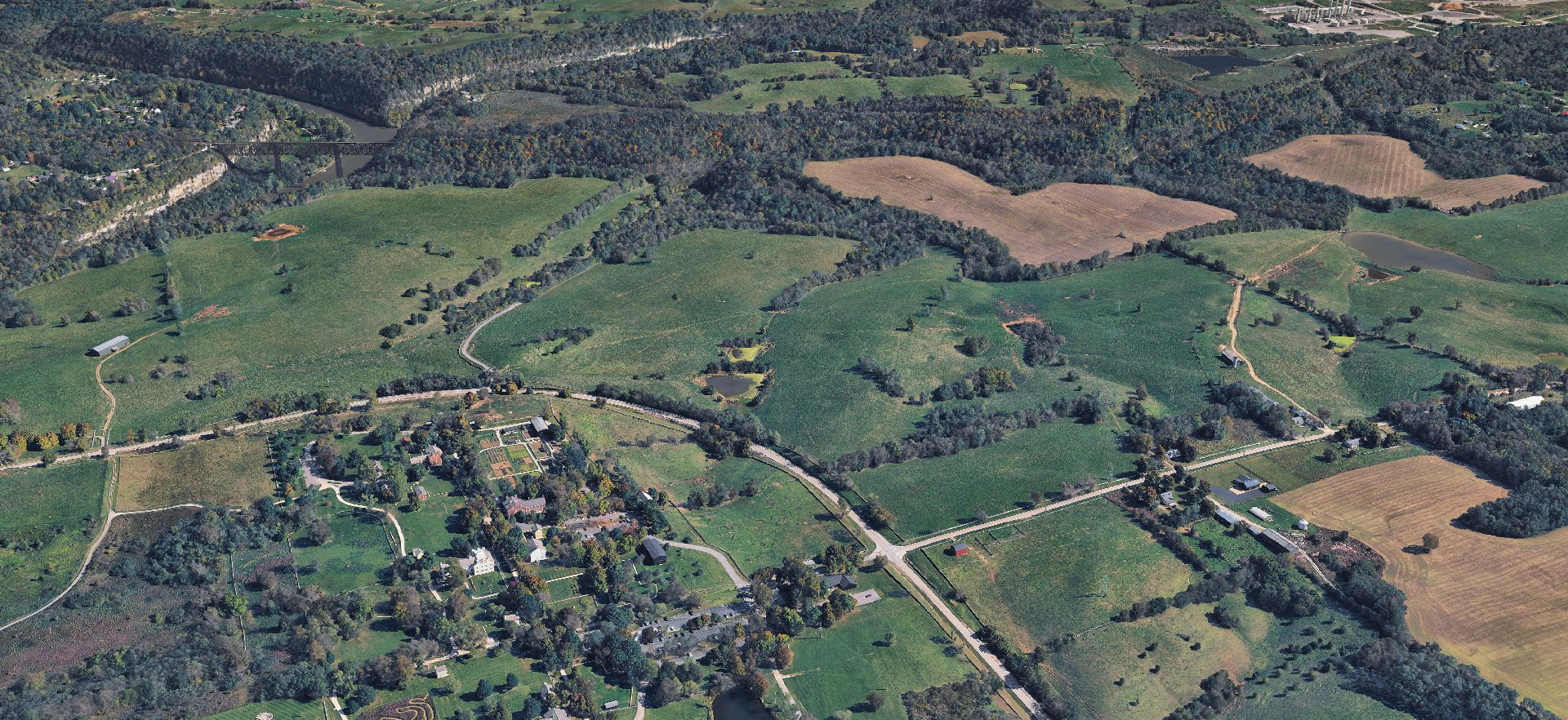
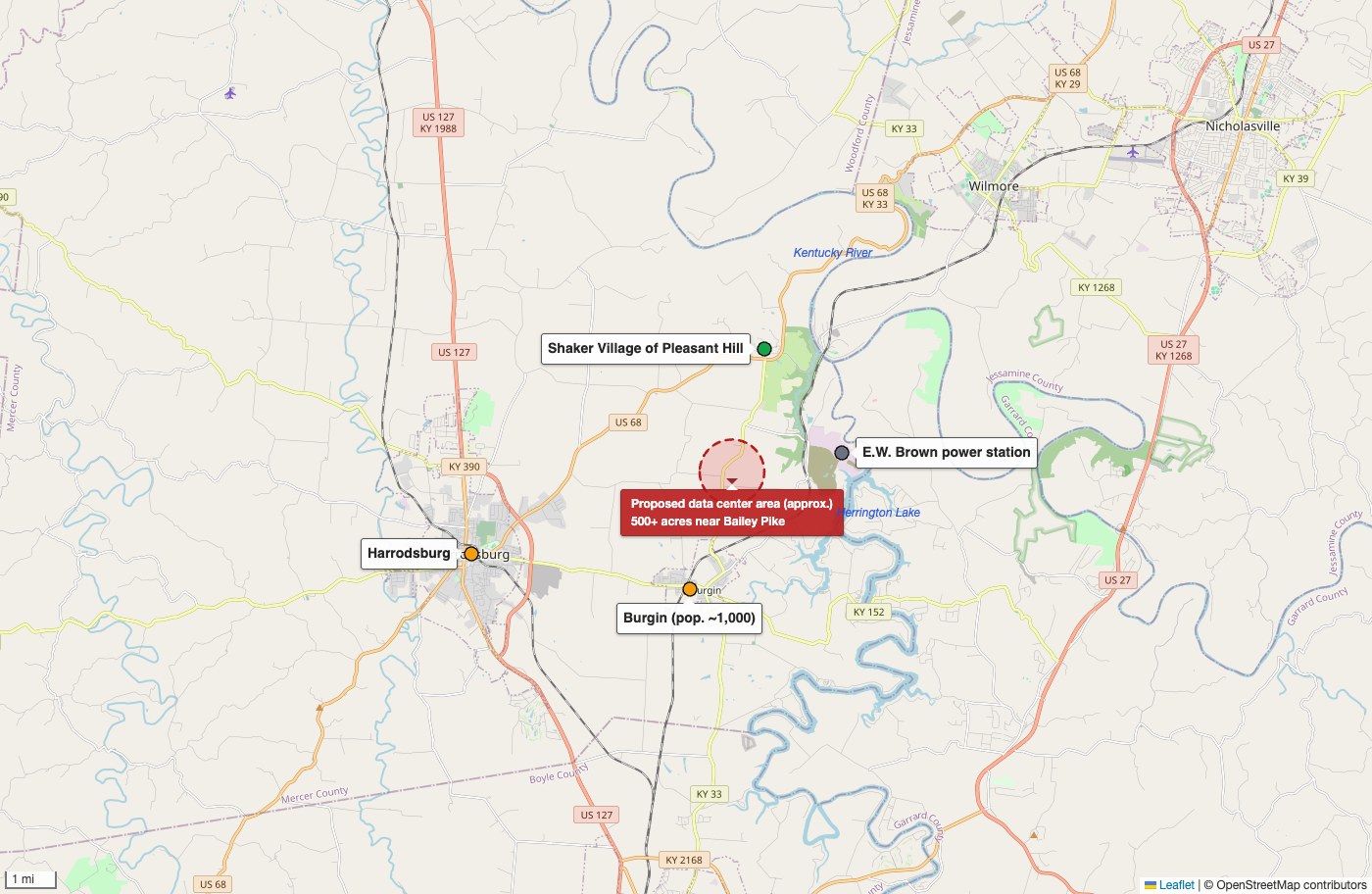
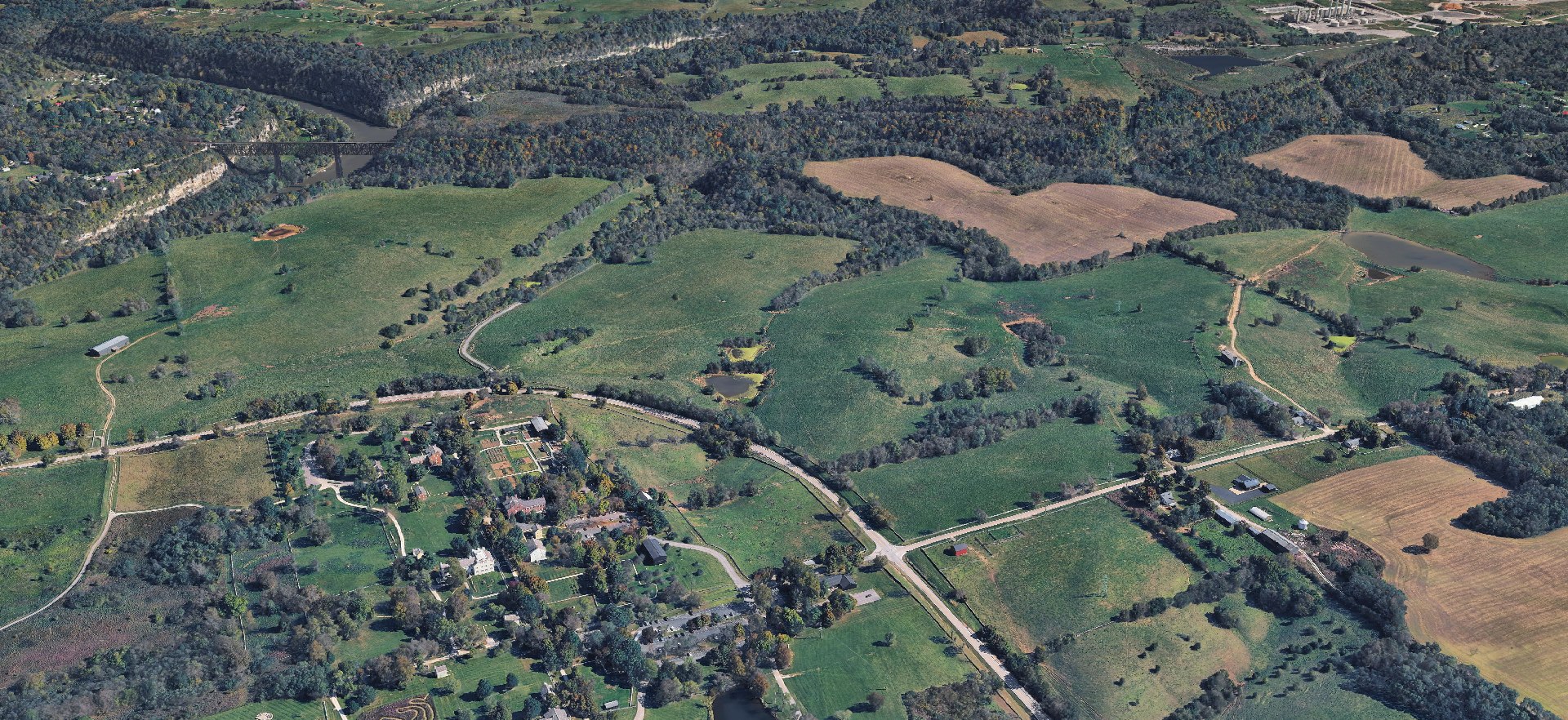
Developers working with American Farm Investors and the real-estate giant JLL have assembled roughly ten properties totaling more than 500 acres of farmland near Bailey Pike in northern Mercer County — about two miles from Shaker Village of Pleasant Hill, the restored 19th-century Shaker settlement that is one of central Kentucky’s signature historic landmarks and a National Historic Landmark district. The site sits near the E.W. Brown generating station, a major LG&E-KU power plant on Herrington Lake — the kind of grid access hyperscale data centers hunt for.
Shaker Village’s leadership has come out hard against the project. CEO Billy Rankin has warned about noise, water, pollution and the region’s tourism economy — and about the process itself. “Making an end around planning and zoning regulations… should be a major red flag,” he told the Burgin City Council in July.
The Burgin end-run
The developers’ problem: Mercer County’s planning and zoning process was not going to give them what they needed, and county officials have been moving toward an outright pause on data center projects.
Their answer was Burgin — a city of roughly 1,000 people wedged between Harrodsburg and Herrington Lake. If Burgin annexes the farmland, the property leaves the county’s zoning jurisdiction entirely; the city, not the county, would then control what gets built. The annexation would roughly double the size of the town.
On July 9, the Burgin City Council gave first reading to the annexation ordinance on a 3–2 vote, over an audience of residents in blue protest shirts. Council members Sindicat “Sid” Dunn and Melinda Wofford voted no — “I’m speaking for the constituents, the folks that elected me,” Wofford said — while supporters argued a developer’s agreement would give the city leverage a county process wouldn’t. A special meeting set for July 20 to finalize the annexation was then abruptly canceled: the city conceded the first meeting had procedural defects, meaning the ordinance has to start over. As of this writing the annexation has not received a valid final vote.
The water, the moratorium and Monday’s vote
Burgin does not control the water a hyperscale campus would need — Harrodsburg supplies it, and Harrodsburg’s leadership has publicly opposed the project, putting Mercer County’s two cities openly at odds. Meanwhile the Mercer County Fiscal Court voted July 29 to advance a countywide data center moratorium; the formal adoption vote is set for Monday, Aug. 11. A county moratorium would not bind Burgin inside its own limits — which is precisely why the annexation matters so much to both sides.
The Lexington connection: Never Say Die
What turned a Mercer County zoning fight into a Lexington story is Luftman’s other project. Never Say Die announced this month that it will open its first “brand home” this fall at 249 W. Short St. downtown — the former Parlay Social space — a $4 million micro-distillery and English-style pub expected to employ about 19 people. The project was approved for state tourism-development incentives in January, a program that lets approved projects recover up to 25 percent of development costs — roughly $1 million here — through sales-tax rebates over the following decade.
Floyd’s posts in Lexington groups connected those dots for Lexington audiences: the man asking Burgin to annex farmland next to Shaker Village is also the man about to open a subsidized bar on West Short Street. Some commenters have called for boycotts of the new venue. It was that campaign, Floyd says, that prompted the message from Luftman’s account.
What happens next
Three things to watch: the fiscal court’s moratorium vote Monday; whether and when Burgin restarts the annexation readings; and whether Luftman, American Farm Investors or Never Say Die respond publicly to the screenshots.
Editor’s note: The Times has redacted Floyd’s booking photo, prior name and the details of her 2023 arrest from the images in this story. The arrest is not the story; the use of it against a critic is. Floyd published the screenshots herself and has spoken publicly about the exchange.
Sources
- Diane Floyd’s Aug. 7 post of the Messenger screenshots, No Kentucky Data Centers group (Facebook)
- Andrew Cooperrider’s Aug. 8 post summarizing the exchange (Facebook)
- “City council in Mercer County advances annexation that could clear way for data center,” Louisville Public Media, July 10, 2026
- “Burgin data center proposal stirs protest, as annexation vote barely clears council,” WUKY, July 13, 2026
- “Burgin city council hears first reading of annexation ordinance that could allow data center,” WKYT, July 10, 2026
- “Mercer County Fiscal Court approves motion for data center moratorium,” WKYT, July 29, 2026
- “President of Shaker Village speaks out against data centers, as developers eye Mercer County,” LEX18, June 2026
- “Mercer County cities at odds over data center annexation,” Kentucky New Era
- “Town of Burgin weighs annexing 500 acres amid data center concerns,” Spectrum News 1, July 13, 2026
- “Never Say Die Whiskey to Open Brand Home in Lexington, Ky.,” Fred Minnick, Aug. 6, 2026
- Gov. Beshear tourism-development incentives announcement including NSD Spirits LLC ($4M Fayette County project, 19 jobs), January 2026
- “Burgin annexation vote for data center project narrowly passes city council,” The Lexington Times, July 13, 2026
This explainer was researched and drafted with AI assistance (Claude Fable 5) by The Lexington Times’ newsroom agent and finalized for publication by the editor. Screenshots, votes, quotations and figures were checked against the cited primary sources and news reports.
Republishing: This is original Lexington Times reporting, licensed under Creative Commons CC BY-ND 4.0. You may republish this article, in full and unaltered, for free — including commercially — with credit to The Lexington Times and a link to the original.