A Lexington bank’s request to disqualify a Fayette Circuit judge has pulled back the curtain on a pattern of overlapping roles that has placed one man — and one law firm — at an unusual intersection of judicial, civic, and legal power in Lexington.
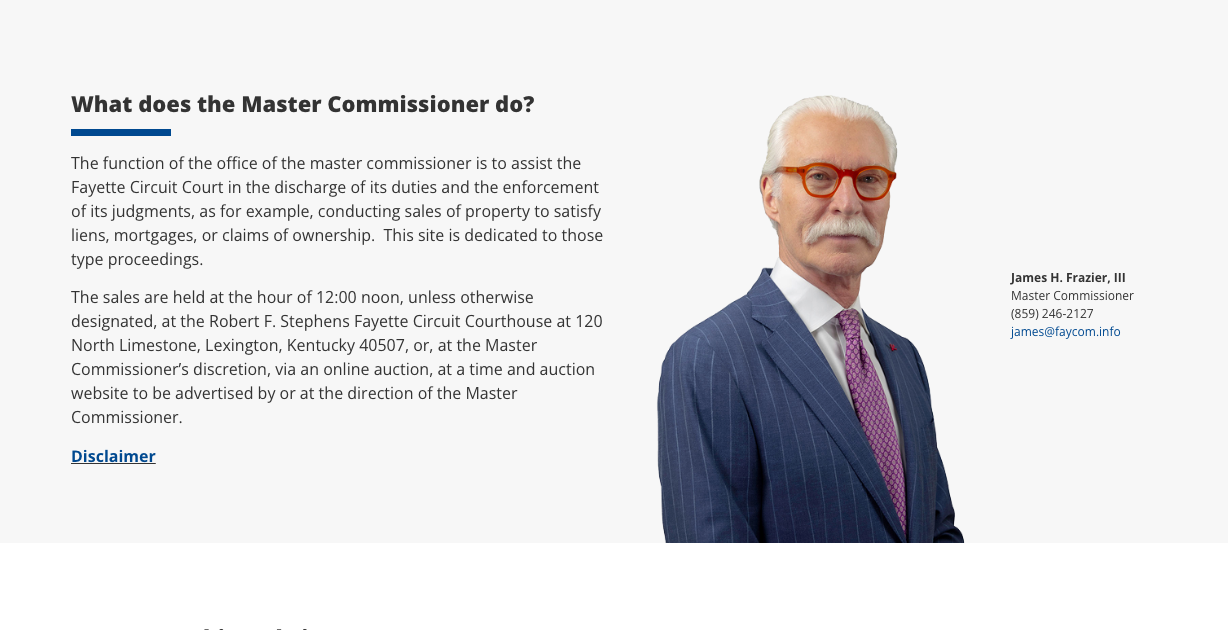
James H. Frazier III is the CEO of McBrayer PLLC, one of Kentucky’s largest and most politically connected law firms. He is simultaneously the Fayette County Master Commissioner, the court-appointed official who conducts property sales in foreclosure proceedings. He chairs the board of the Lexington Parking Authority. And since earlier this year, he has been one of several attorneys defending Fayette Circuit Judge Julie Muth Goodman against an unprecedented effort by the Kentucky General Assembly to impeach and remove her from office.
It’s that last role that has landed him — and Judge Goodman — in the middle of a recusal controversy.
Lawyers for Bancorp, a Minnesota-based lender seeking to recover money on several deteriorated West Lexington apartment properties totaling up to 400 units, filed a motion March 30 asking Goodman to step aside from their case. Their reason: Goodman had appointed Frazier as receiver in the Bancorp foreclosure action in February 2025, but never disclosed that Frazier’s firm was simultaneously representing her in arguably the most consequential legal fight of her career.
“Any reasonable observer apprised of these facts would question Judge Goodman’s impartiality in reviewing objections in this case to attorney Frazier’s and the McBrayer Firm’s fees, when she is personally and simultaneously paying invoices to the McBrayer Firm in the impeachment proceedings.”— Bancorp attorneys, affidavit filed March 30, 2026
Frazier, who was billing $550 an hour as receiver, resigned the day after the recusal motion was filed. He told the Herald-Leader he stepped aside because prolonged litigation over the motion would delay repairs to homes where families were struggling — citing one example of residents using charcoal grills indoors for heat. He called the recusal effort a “political diversion.” Frazier also maintained that because a receiver is not a party to a case, no disclosure was required.
Goodman has recused herself in at least three other cases involving McBrayer, according to Bancorp’s filing. She did not respond to requests for comment.
A Footprint That Extends Across Lexington’s Institutions
The controversy is notable in part because of how deeply Frazier and McBrayer are embedded in Lexington’s civic infrastructure. Frazier has served as Master Commissioner of the Fayette Circuit Court since 2008, having previously held the role of Chief Deputy Master Commissioner going back to 1992. That office — which conducts court-ordered property sales in foreclosure cases — is the same institutional role that led directly to his appointment as receiver in the Bancorp matter.
Beyond the court and the firm, Frazier chairs the board of the Lexington Parking Authority and has chaired the Kentucky Master Commissioners Advisory Board. He has also served on the Board of Directors for Commerce Lexington and the Board of Trustees for Transylvania University.
As of January 1, 2026, Frazier transitioned from Managing Member to CEO of McBrayer PLLC, with Jaron Blandford succeeding him as Managing Member — a structural change that did not reduce his prominence at the firm.
Frazier has spoken openly about the relationship between civic involvement and institutional influence. In a prior interview, he described community service as an investment in the firm’s identity: “They know who you are. That means they know who the law firm is.”
The VisitLEX Connection
The Bancorp recusal dispute is not the first time McBrayer’s dual role as legal counsel and civic actor has raised questions in Lexington. A February 2026 investigation by The Lexington Times revealed a striking conflict involving the firm’s work for VisitLEX, the quasi-governmental tourism bureau funded by hotel tax revenue.
When an outside accounting firm was hired to audit VisitLEX following a public complaint about $284,745 in staff bonuses, the auditors did not conduct their own independent legal analysis of whether the bonuses were lawful. Instead, they obtained a legal opinion from Anne-Tyler Morgan, an attorney at McBrayer PLLC, who concluded that VisitLEX employees were not subject to the state law prohibiting local governments from paying bonuses.
Billing records obtained through an open records request revealed that McBrayer was simultaneously on a $5,000 monthly retainer with VisitLEX for government relations — lobbying work — at the time the opinion was issued. Records show VisitLEX paid 12 such monthly invoices in 2025, meaning the firm collected at least $60,000 that year from the very entity whose bonus practices it was being asked to validate.
In other words: McBrayer told VisitLEX it wasn’t breaking the law, while VisitLEX was paying McBrayer to lobby on its behalf — using public tax dollars. Neither LFUCG nor the state auditor sought an independent legal opinion or asked the Kentucky Attorney General to weigh in.
A Pattern Worth Examining
Taken together, the two episodes — the Bancorp receivership and the VisitLEX opinion — reveal something worth examining beyond the individual conflicts. McBrayer occupies an unusual position in Lexington: it is simultaneously a private law firm, a registered lobbying operation, a provider of quasi-judicial services through Frazier’s Master Commissioner role, and now the legal defense team for a sitting circuit judge.
Each of those roles, in isolation, may be entirely proper. But when a firm’s CEO is conducting court-ordered property sales as a public officer, taking appointments as receiver from judges his firm represents, and issuing legal opinions to public entities his firm is being paid to lobby — the overlaps multiply in ways that standard conflict-of-interest disclosures may not fully capture.
Frazier declined to acknowledge any ethical problem with the Bancorp arrangement. The Kentucky Supreme Court must now decide whether to appoint a special judge to the case while a replacement receiver is named.
What remains clear is that in Lexington’s relatively small legal and civic ecosystem, McBrayer’s reach — and Frazier’s in particular — extends into corners of public life that most private law firms never touch. Whether that reach constitutes a conflict depends on who you ask. But the question, at this point, is being asked in open court.
Republishing: This is original Lexington Times reporting, licensed under Creative Commons CC BY-ND 4.0. You may republish this article, in full and unaltered, for free — including commercially — with credit to The Lexington Times and a link to the original.