by Paul Oliva, Lexington Times Web Editor
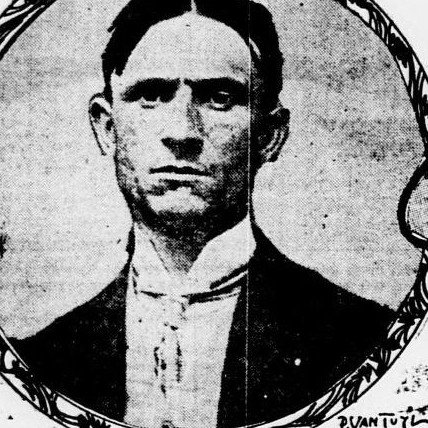
Editor’s note: In August 2023, this publication ran a remembrance of Michael Joseph “Mickey” Shannon, the Irish-born horseman who edited the original Lexington Sunday Times in 1911 — the colorful predecessor whose name we carry. Three more years of digging — through the digitized Lexington Herald and Lexington Leader, the Library of Congress’s Chronicling America archive, and the Daily Racing Form’s digitized back numbers — has turned up a Mickey Shannon even better than the one we knew: a man who edited not one but three newspapers, lost a mule race aboard a borrowed jack named Steamboat Bill, published a satirical balance sheet of his own failures, took golf lessons from John McGraw in Havana, and earned, in death, some of the warmest obituaries the turf press ever printed. This is the updated story, told as much as possible in the words of the people who watched him live it. Every newspaper quoted below is in the public domain.
A lad out of Limerick (or Kerry — even the obituaries argued)
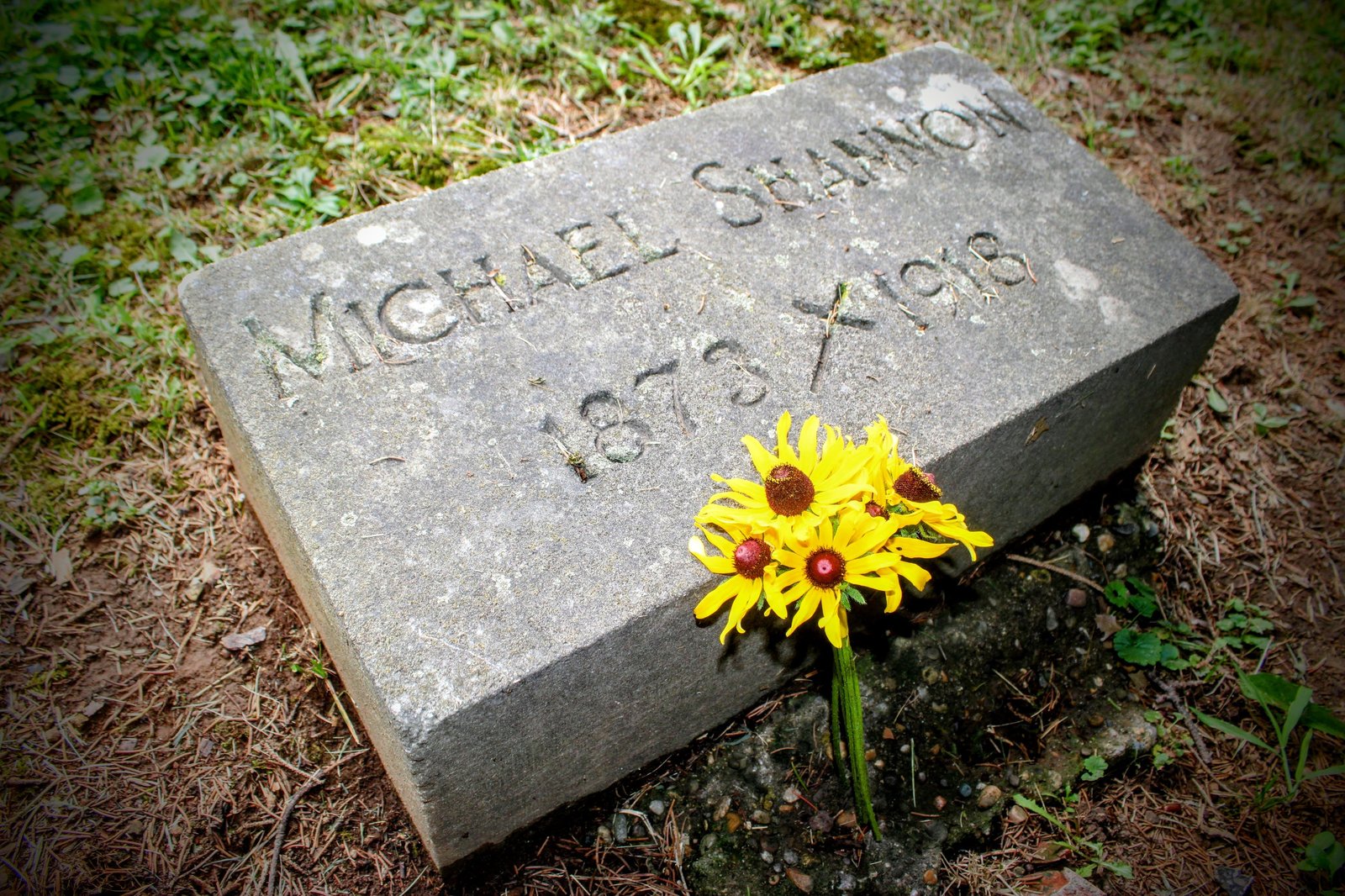
Start with the facts nobody could agree on. The Lexington Herald‘s obituary has Michael Joseph Shannon born in County Kerry; the Daily Racing Form‘s obituary and a long 1904 profile in the St. Louis Republic both say Limerick. His headstone at Calvary Cemetery says 1873; the Lexington papers guessed “about forty years ago” (call it 1878); the 1904 profile made him just 23, which would mean 1881. A man who once inventoried his own editorship at “Told lies 1,728 times. Told the truth 1 time” would, we suspect, be delighted that the record keeps everyone honest by keeping no one certain.
What the sources do agree on: his father went ahead to Chicago and, in 1891, sent for his three sons — Mickey, Tom and Jack. (Daily Racing Form, Nov. 8, 1918) The Lexington Herald adds the detail that the boy started life in America “as a bell hop in a Chicago hotel.” By 1895 he was an exercise boy and apprentice jockey for John Huffman, riding at a featherweight 68 pounds and winning his first races on a horse called First Deal. (St. Louis Republic, July 3, 1904; Daily Racing Form, Nov. 8, 1918)
From there the résumé runs like a steamer itinerary. He trained for George C. Bennett, the Tennessee turfman — “and for the Tennessee horseman Shannon won many races with the fast mare Dishabille, and with several other useful thorobreds owned by Bennett,” the Leader recalled (Lexington Leader, Nov. 6, 1918) — after serving as assistant to Henry McDaniel, who would later train the immortal Exterminator. He worked as betting agent for the famous plunger Charley Ellison and handled S.S. Brown’s horses at New Orleans. He spent about a year in Germany as assistant to George Walker, the American trainer then conditioning horses for the Weinberg brothers. He saw, by the Leader‘s count, “nearly every race course on this continent, as well as in Mexico and Cuba.”
And when the race-riding wound down, he became something rarer: “a general utility man about the race courses, assisting the secretaries, sending out reports of the work of the horses in training, and writing accounts of the sport in poetry and prose. He was known as the bard of the turf, his stories being read by followers of the sport, while his poems gave delight to many readers because of the wit and style of the writer.” (Lexington Leader, Nov. 6, 1918)
He never entirely quit the saddle, either. At a Louisville old-jockeys’ exhibition race in 1905, the Courier-Journal found “Mickey Shannon, ‘the Celtic Bard,’ leading the procession on Ed Corrigan’s Dunning, which was quoted at 18 to 1. The fair sex rooted hard for the engaging Mickey,” who announced as he rode back to the scales: “When I get off this one I’ll never get on another.” (Courier-Journal, July 19, 1905)
He did not keep that promise. More on the mule later.
The Moonlight Trill: the bard’s actual verse
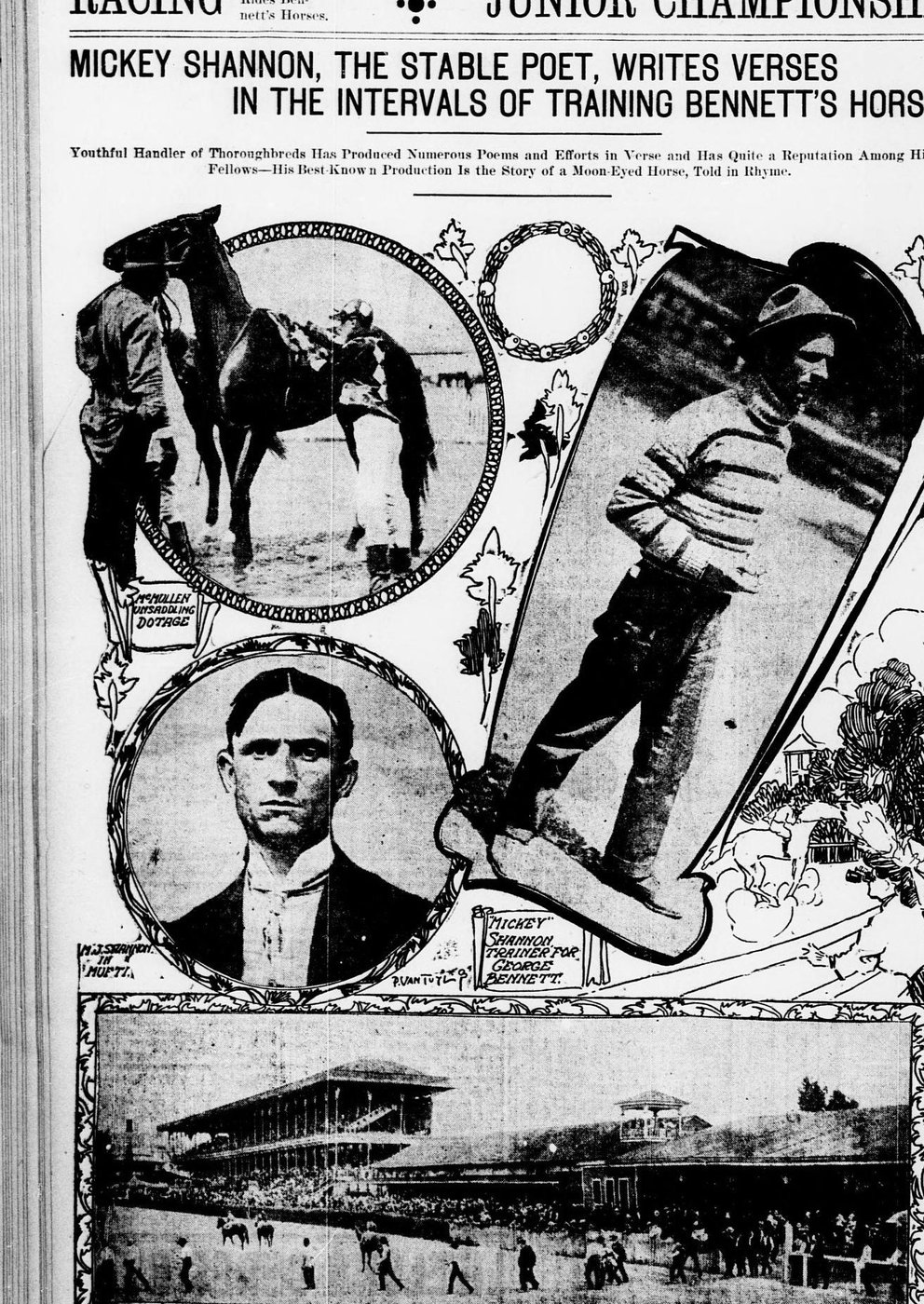
For all the talk of Shannon’s “numberless doggerels and ditties,” the 2023 article couldn’t quote a single line of them. The St. Louis Republic could. In 1904 it profiled “Mickey Shannon, the stable poet,” and reprinted his best-known work — a ballad about an owner who clocks his horse working a sensational mile by moonlight, pawns his diamonds, bets the bankroll, and watches the field cross the wire with his horse last:
An owner had a horse whose form was good.
To work him a mile he thought he should…
The owner then noted the work he had done,
For his watch showed the mile run in 1:41…
He said to the jockey, “Now, sure, don’t be slow,
Be off in the front when the starter says ‘go.’”…
But his mount shot his bolt when the half mile was past,
And the field crossed the wire with the horse at last.
And the bookies all laughed and the owner grieved,
And said, “He can’t run, for he’s surely moon-eyed.”from “The Moonlight Trill,” as printed in the St. Louis Republic, July 3, 1904
The paper credited Shannon with coining “moon-eyed” for any horse whose moonlit works were “altogether unreliable as indicating the true form.” Every handicapper who has ever trusted a workout tab has met a moon-eyed horse.
Three newspapers, counting the insect
The 2023 version of this story knew about one Mickey Shannon newspaper. There were three.
In Memphis — where he wintered with the Bennett and Ellison strings at Montgomery Park, the track he was “pleased to call home” (Courier-Journal, Feb. 16, 1903) — he edited something called The Gabby Row Dispatch, gabby row being the stretch of stables where the talk runs fastest. (Lexington Leader, Aug. 26, 1911)
Then, in early August 1910, Lexington got The Bumble Bee. “The Bumble Bee, a four-page breezy paper edited by Mickey Shannon, made its first appearance last Saturday,” reported the Mt. Sterling Advocate of Aug. 10, 1910. “The paper is filled with light gossip of the city and county and contains many pertinent paragraphs on timely themes. The Bumble Bee’s motto is ‘We were born with a stinger and we know how to use it.’” The Lexington Leader would remember it as “the snappy little journalistic insect that stung its way along a shining route last fall, and left many a swolen bump in its pathway.” (Lexington Leader, May 8, 1911)
When the Bumble Bee folded, Shannon did what any newspaperman of sufficient self-knowledge would do: he published the books. The Leader ran it, at his request, as “Mickey’s Inventory”:
Been broke 361 times.
Had money 4 times.
Praised in public 9 times.
Told lies 1,728 times.
Told the truth 1 time.
Missed prayer meeting 52 times.
Been roasted 431 times.
Roasted others 52 times.
Washed office towel 3 times.
Missed meals 0.
Mistaken for preacher 11 times.
Mistaken for capitalist 0.
Found money 0.
Took bath 6 times.
Delinquents who paid 23.
Those who did not pay 136.
Paid in conscience 0.
Got whipped 0.
Whipped others 23 times.
Cash on hand at beginning $1.47.
Cash on hand at ending 15c.Lexington Leader, May 8, 1911

That spring he was also quietly holding down the Leader‘s own sporting columns “during the enforced absence by illness of King Welsh,” and writing bylined turf dispatches — including an August 1911 column on rumors that August Belmont would ship his breeding stock abroad if anti-racing legislation kept advancing. (King Welsh, the young Leader sportsman “very popular with Kentucky turfmen and ball players,” died of tuberculosis of the spine the following February.)
The Lexington Sunday Times: two issues of glory
On Saturday, Aug. 26, 1911, the Leader announced the venture this publication is named for: “SHANNON’S PAPER — Lexington Sunday Times Will Make Its First Appearance Tomorrow Morning.”
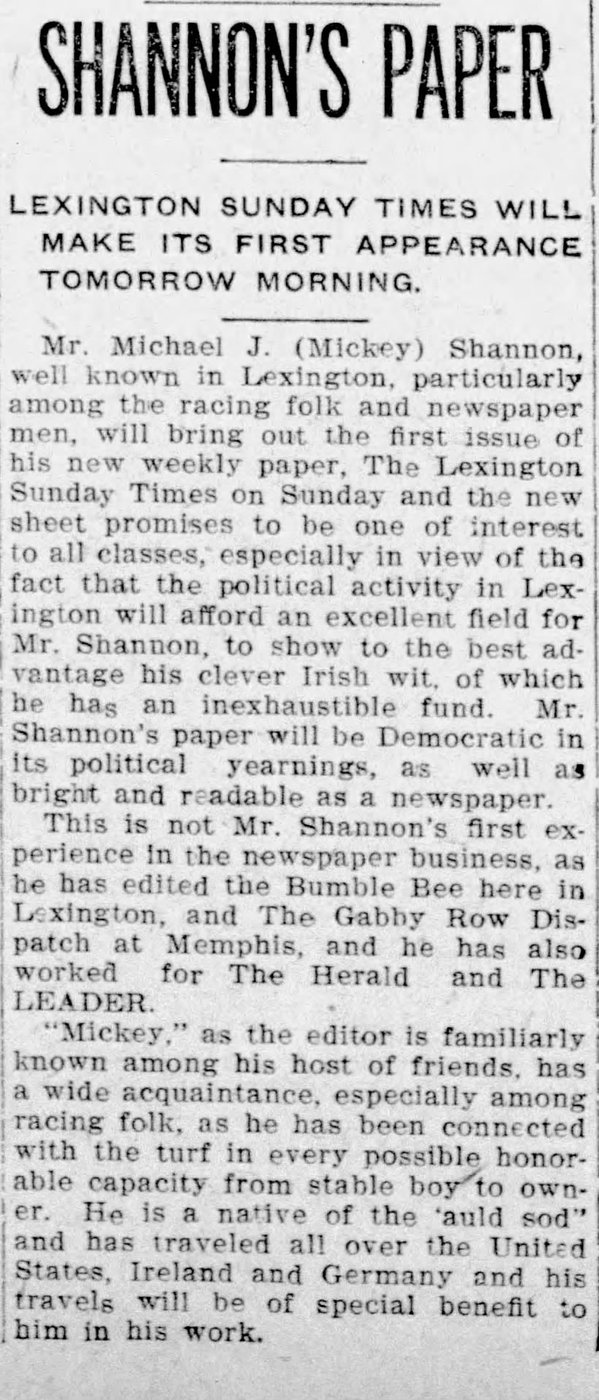
The launch story is the best capsule biography Shannon ever got while alive. The new weekly would be “Democratic in its political yearnings, as well as bright and readable as a newspaper,” and Lexington’s roiling municipal politics “will afford an excellent field for Mr. Shannon, to show to the best advantage his clever Irish wit, of which he has an inexhaustible fund.” As for credentials: “he has been connected with the turf in every possible honorable capacity from stable boy to owner. He is a native of the ‘auld sod’ and has traveled all over the United States, Ireland and Germany.” (Lexington Leader, Aug. 26, 1911)
The first issue appeared Sunday, Aug. 27, 1911 — “a bright little seven-column, eight-page weekly, devoted principally to live sport news, featuring news of the turf,” with a side helping of Democratic politics. (Lexington Herald, Sept. 6, 1911) It was printed at Griffith & Crowe’s plant at 140 South Limestone, which doubled as the paper’s business and editorial office, and the Leader judged the first number “a most creditable sheet both from a literary and typographical point of view” — its editor “a born lover of the turf” whose “Irish blood in his veins makes him take as naturally to politics as a duck to water.” (Lexington Leader, Aug. 28, 1911)
It lasted exactly two issues.
How it ended depends on which paper you read — and the two Lexington dailies, never shy about needling each other, told it two different ways. The Republican-leaning Leader put it on the front page of Sept. 5 under the headline “MACHINE SUNDAY PAPER GIVES UP”: Shannon, it reported, “announced Tuesday the suspension of the paper, saying that the Democrats did not give it the financial assistance that he had hoped for, and as he had no battle of his own to fight, he could not afford to make a personal and financial sacrifice for the various candidates and the party, which would not ‘put up.’ It takes something besides ‘wind,’ he declared, to publish a newspaper.”
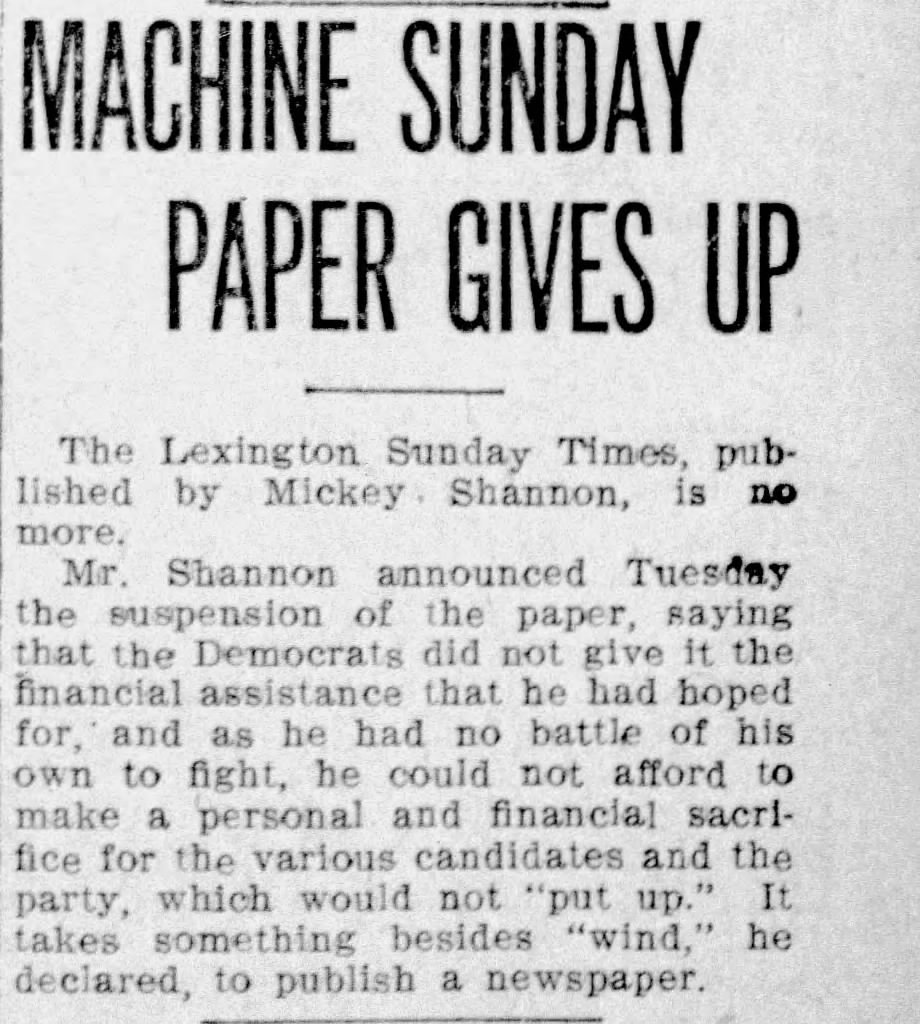
The Herald — the town’s Democratic paper — ran Shannon’s rebuttal the next morning: “Contrary to a report by a Lexington paper that The Times was a ‘machine’ paper, and that its publication would be suspended because the local Democratic organization would not ‘put up’ anything to keep it going, Mr. Shannon said last night that he had asked backing of no one.” The paper died, he said, simply because “the profits failed to justify its publication.” The Herald added a gentle eulogy: “Its number of friends gained by its two issues, and Mr. Shannon’s host of friends, will regret that it became necessary for its publication to be suspended.” (Lexington Herald, Sept. 6, 1911)
Whichever version you believe, the “wind” line deserves its place in Kentucky journalism lore — and 115 years later, a publication bearing the Lexington Times name can confirm: he was right.
Steamboat Bill, by Slickaway, out of Calamity
Here is what the 2023 article missed entirely, and what may be the most Mickey Shannon story ever printed.
In the very same August weeks he was launching his newspaper, Shannon entered the comic mule race at the Blue Grass Fair — a half-mile dash for local Elks, starting at the grandstand, “circling a barrel at the quarter pole” and coming home. The Herald covered the training season like a stakes preview, reporting that the riders “have made their wills and picked out their executors” and were teaching their mounts “the moral difference between dashing through the infield fence and peeling the skin off their riders, and that of remaining on the track and making an honest effort to win the cup.” (Lexington Herald, Aug. 3, 1911)
Shannon, “who has been trying to bluff other contestants with the declaration that he was once a jockey and won several big races in Ireland, met with an accident Tuesday that not only took the vanity out of Shannon but came near converting him into a scrambled egg.”
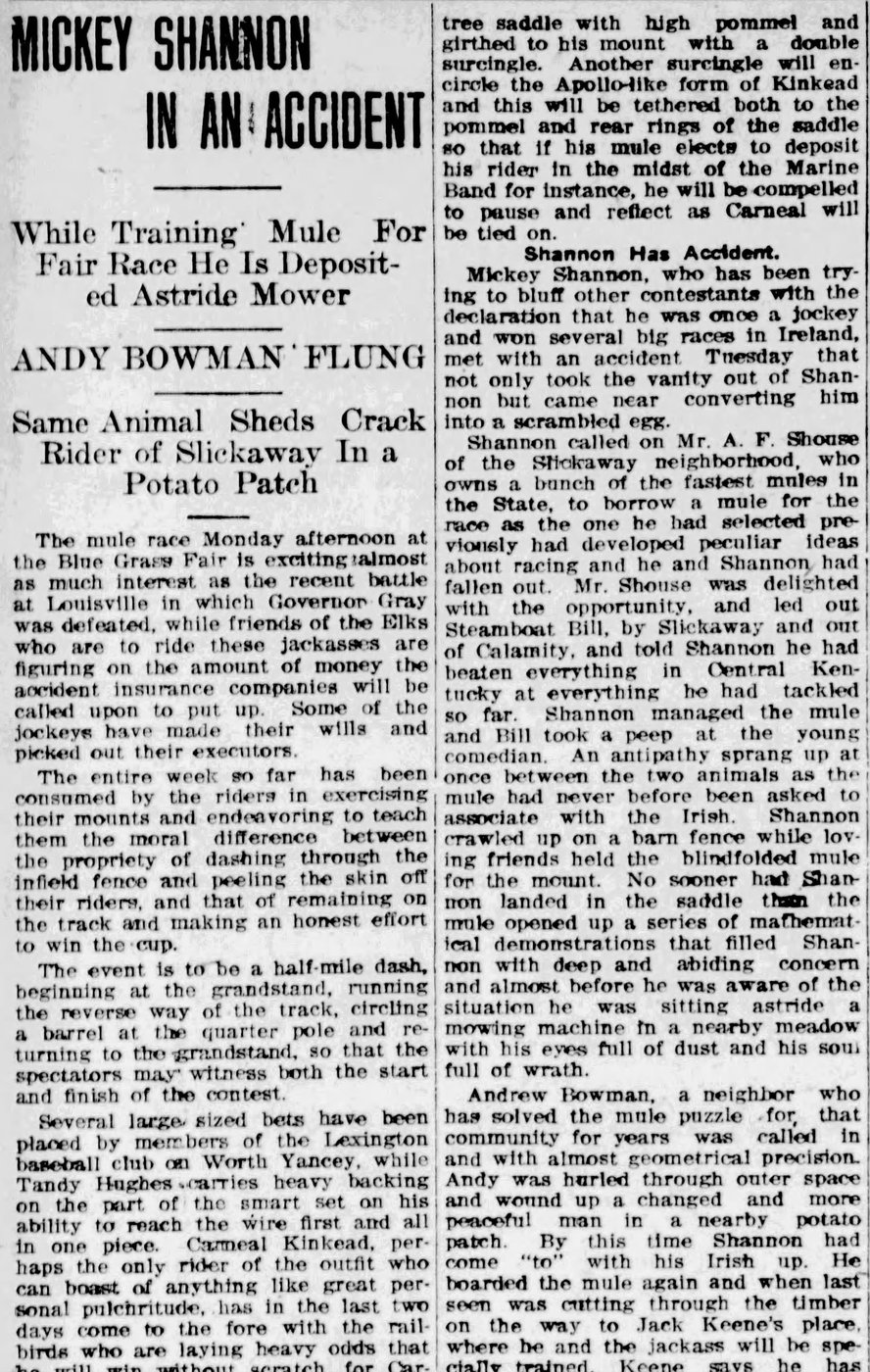
He had borrowed his mount from A.F. Shouse of the Slickaway neighborhood, “who owns a bunch of the fastest mules in the State” — a jack named Steamboat Bill, with the impeccable mule pedigree by Slickaway, out of Calamity. The introduction did not go well: “An antipathy sprang up at once between the two animals as the mule had never before been asked to associate with the Irish. Shannon crawled up on a barn fence while loving friends held the blindfolded mule for the mount. No sooner had Shannon landed in the saddle than the mule opened up a series of mathematical demonstrations that filled Shannon with deep and abiding concern and almost before he was aware of the situation he was sitting astride a mowing machine in a nearby meadow with his eyes full of dust and his soul full of wrath.”
A neighbor, Andrew Bowman — the man who “has solved the mule puzzle for that community for years” — was called in to help and “was hurled through outer space and wound up a changed and more peaceful man in a nearby potato patch.”
Then comes the detail that makes a Lexington reader sit up. Shannon, “with his Irish up,” remounted, and “when last seen was cutting through the timber on the way to Jack Keene’s place, where he and the jackass will be specially trained. Keene says he has trained thoroughbreds in Russia and is the man who gave his record to the immortal Irish Lad, but he frankly confesses that this is the first time he” had taken on a mule. That would be John Oliver “Jack” Keene — the horseman whose farm on the Versailles Pike would become Keeneland. Mickey Shannon’s mule may be the least distinguished trainee in the history of that storied ground.
The race itself, on Aug. 7, went to John Galvin’s mount. But the Herald‘s account preserved a glimpse of the rider Shannon had once been: “Mickey Shannon on ‘Steamboat Bill,’ made a determined bid. This son of Erin put up one of those rides which characterized him when he was one of the star riders of the thoroughbred turf.” A foul claim — alleging the mules had failed to properly round the barrel — was heard and dismissed. (Lexington Herald, Aug. 8, 1911)
Shannon liked the bit too much to let it die. By 1915 he was back at the Blue Grass Fair as “Colonel Mickey Shannon,” organizing what the Herald called the Transylmulia Stake — a name that suggests the town’s oldest university was in on the joke. (Lexington Herald, July 27, 1915)
The pig
No retelling of Mickey Shannon is complete without the pig, and the Herald‘s obituary gave it a full column inch of dignity: “In Lexington this rollicking Irishman will be remembered as the owner of a famous pet pig, and just as there was only one Mickey Shannon, so there was only one trained pig. ‘Mickey’ had trained this animal so that it had all the characteristics of a well trained dog. The pig followed Shannon about as would a dog, down the street, into the house and out upon the turf. The pig would perform most obligingly for any crowd. Seldom for his own benefit, but often for that of others Shannon would give exhibitions of the skill of his pet.” (Lexington Herald, Nov. 7, 1918)
That last clause is the whole man in miniature: the show was never for his own benefit.
Havana, the mutuels, and golf with McGraw
Shannon’s last great adventure came courtesy of Cuba. When Lexington’s racing men helped stock the new winter meeting at Havana’s Oriental Park, “Migratory Mickey, otherwise Michael Joseph Shannon,” went along — “to be a functionary of some sort at the Cuba-American Jockey Club’s winter meeting of 82 days,” as the Daily Racing Form put it under the headline “‘MICKEY’ SHANNON FINDS PARADISE.” (Daily Racing Form, Dec. 6, 1915)
By February 1916 the Form‘s Havana correspondent reported Shannon working in the mutuels department — and taking golf lessons from his old friend John McGraw, the New York Giants manager, who wintered in Cuba. (Daily Racing Form, Feb. 17, 1916) The Lexington obituaries would remember McGraw as “a boon companion of Shannon,” one of the many baseball men and prizefighters in his orbit.
Back home he kept busy in every capacity the turf offered a man of wit: assistant paddock judge at the Lexington and Louisville meetings, auctioneer — the Thoroughbred Record noted in 1916 that “Auctioneer Mickey Shannon got the horsemen into a good humor with some Irish wit” — and, in the fall of 1916, founder of something called the Old Rosebud Minstrels and Good Fellowship Club, named for the Kentucky-bred Derby winner. He had even, at his flushest, headed his own racing stable, which he named with perfect self-awareness: the Needmore Stable, Limited. (Courier-Journal, Dec. 15, 1907)
The kindness of the racing world
The end of Shannon’s story is sadder than the 2023 article knew, and also kinder.
In his last working years Shannon was assistant to trainer Galen Brown at Hot Springs, Arkansas — a circuit he had ridden for a decade, having trained Robert Tucker’s two-year-olds at the Oaklawn winter meet as far back as 1907. It was at Hot Springs that his health broke. He “was found wandering on the streets of that city by Mrs. John W. Schorr, of Memphis, Tenn., wife of the noted horseman” — the Schorrs being one of the most prominent racing families in the South, and a stable that had once tried to hire Shannon away. “Following this he had a nervous breakdown and a mental collapse.” (Lexington Herald, Nov. 7, 1918)
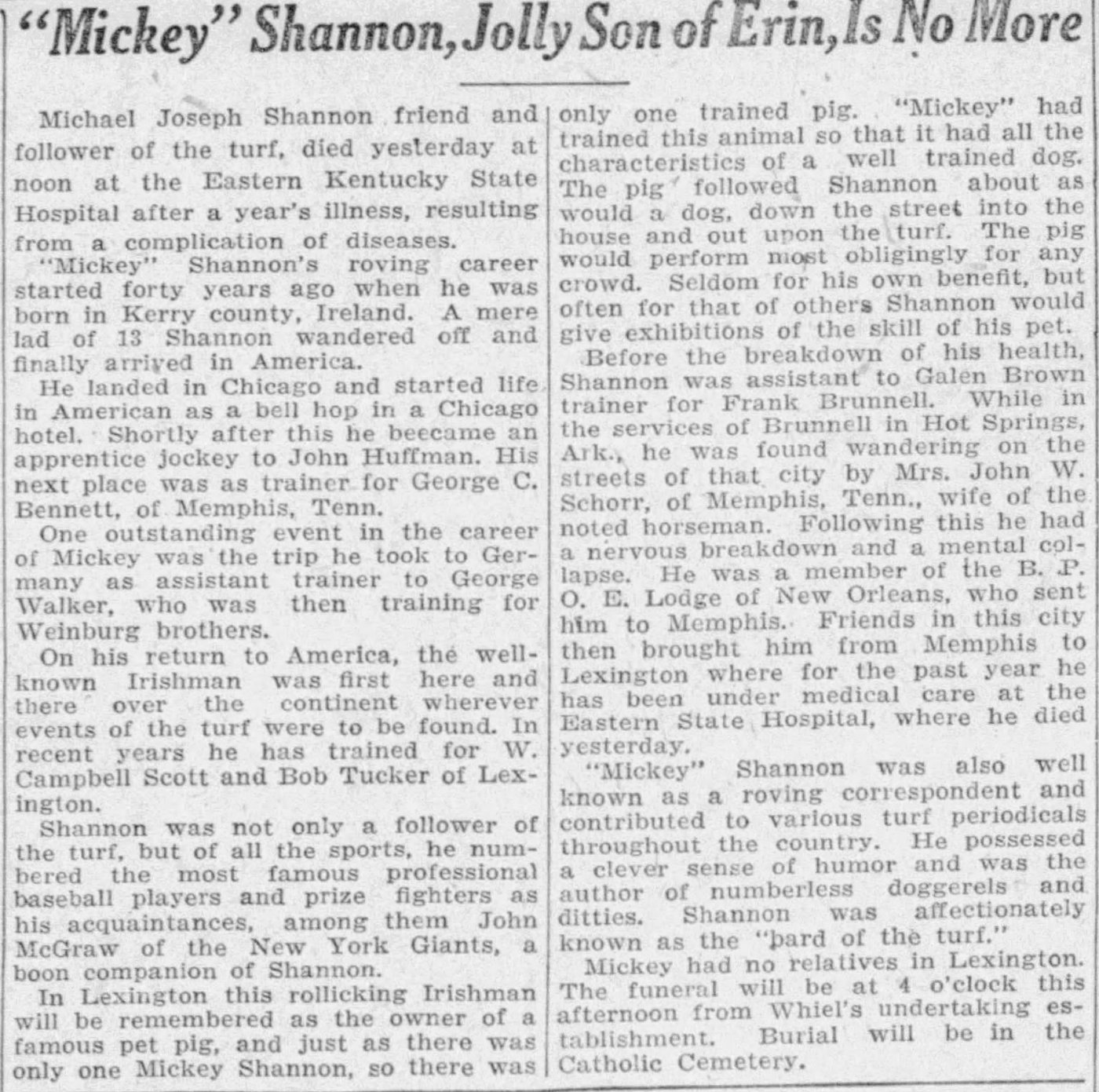
What happened next is a portrait of how the racing world took care of its own. Shannon was a life member of the New Orleans lodge of the Elks, “who sent him to Memphis.” In April 1918 the Daily Racing Form reported that friends, working through John W. Schorr, had arranged to bring Shannon from Memphis to Lexington for treatment. “Friends in this city then brought him from Memphis to Lexington where for the past year he has been under medical care at the Eastern State Hospital.” (Lexington Herald, Nov. 7, 1918; Daily Racing Form, Apr. 13 and 16, 1918)
He died there at noon on Nov. 6, 1918, “after a year’s illness, resulting from a complication of diseases.” “Mickey had no relatives in Lexington,” the Herald noted. The funeral the next afternoon was, in the Daily Racing Form‘s words, “largely attended by horsemen and the local order of Elks.” He was buried in the Catholic cemetery on West Main Street — Calvary Cemetery, where his headstone still stands.
The Leader‘s farewell remains the best summary anyone has written of him: “No turfman of recent years has occupied quite the same position in connection with racing as the cheery little Irishman who loved a horse and was as keen on the subject of racing as the most successful owner of a powerful stable. His humor was unexhaustible, and his friends frequently found themselves the butt of a harmless jest that was given in the best of spirits and rarely caused distress to the victim.” He was, the paper said, “invariably cheerful, always courteous and as happy in his days of trouble as when life put on a brighter hue… at all times ready to help a fellow scribe if within his power to do so.” (Lexington Leader, Nov. 6, 1918)
Coda: an inventory of our own
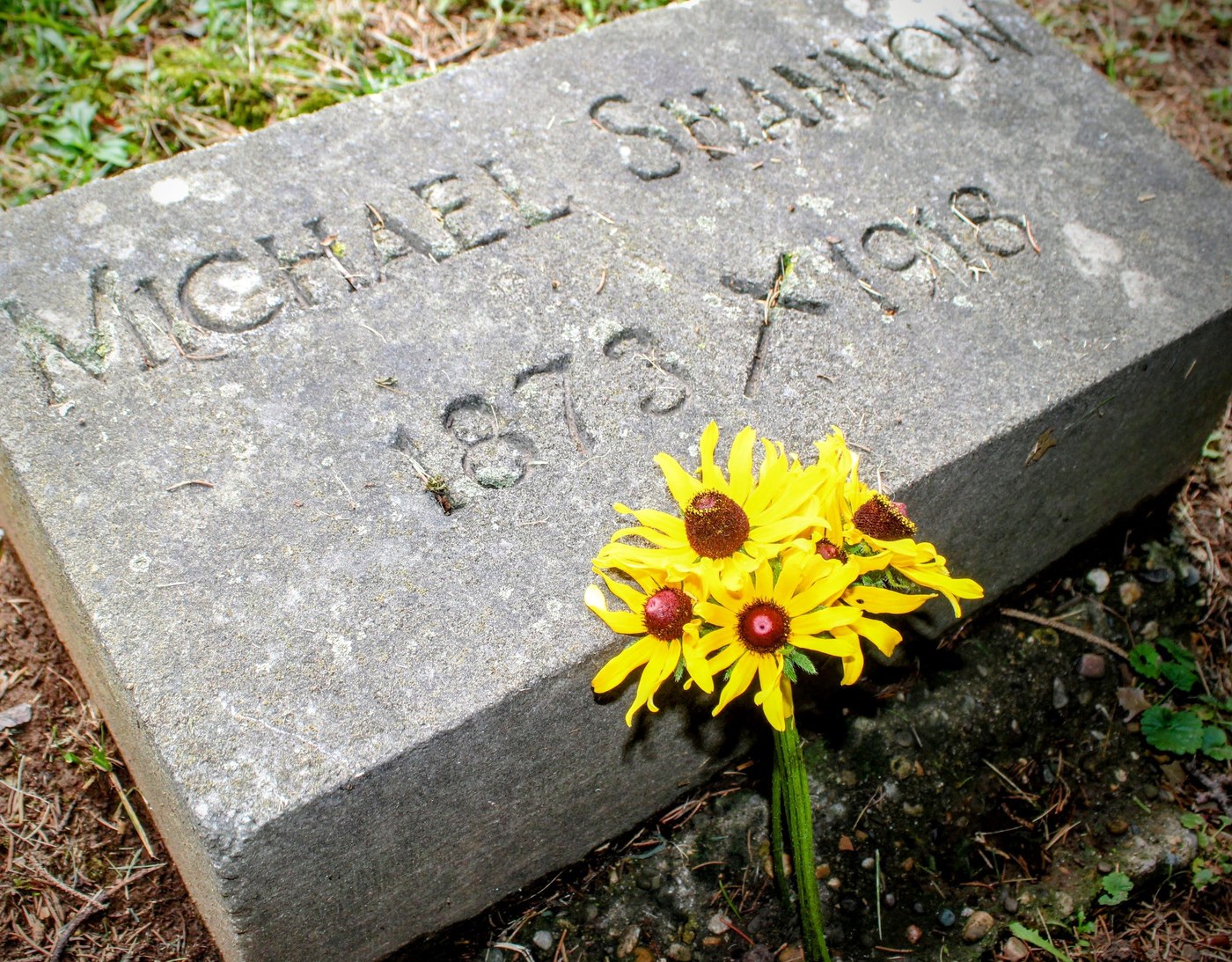
Mickey Shannon’s Lexington Sunday Times printed two issues and died for want of something besides wind. The masthead he chose has had more lives than he could have guessed. From the desk that figuratively descends from his, we’d like to close the ledger the way he would have — with an honest inventory. Told the truth: considerably more than once, we hope. Cash on hand at the beginning: not much. Cash on hand at the ending: that’s the racing business. Friendship valued, per his obituaries, “above anything on earth”: beyond appraisal.
Sources: Lexington Herald and Lexington Leader (1911–1918); St. Louis Republic, July 3, 1904, and Courier-Journal (1903–1907) via the Library of Congress’s Chronicling America; Daily Racing Form (1915–1918) via the Keeneland Library archive; Find a Grave memorial 96312735. All newspaper material quoted is in the public domain.
This article was researched and drafted with AI assistance, working from digitized newspaper archives, the Library of Congress, and the Keeneland Library’s Daily Racing Form archive. It was reviewed, edited and published by Paul Oliva.
Republishing: This is original Lexington Times reporting, licensed under Creative Commons CC BY-ND 4.0. You may republish this article, in full and unaltered, for free — including commercially — with credit to The Lexington Times and a link to the original.