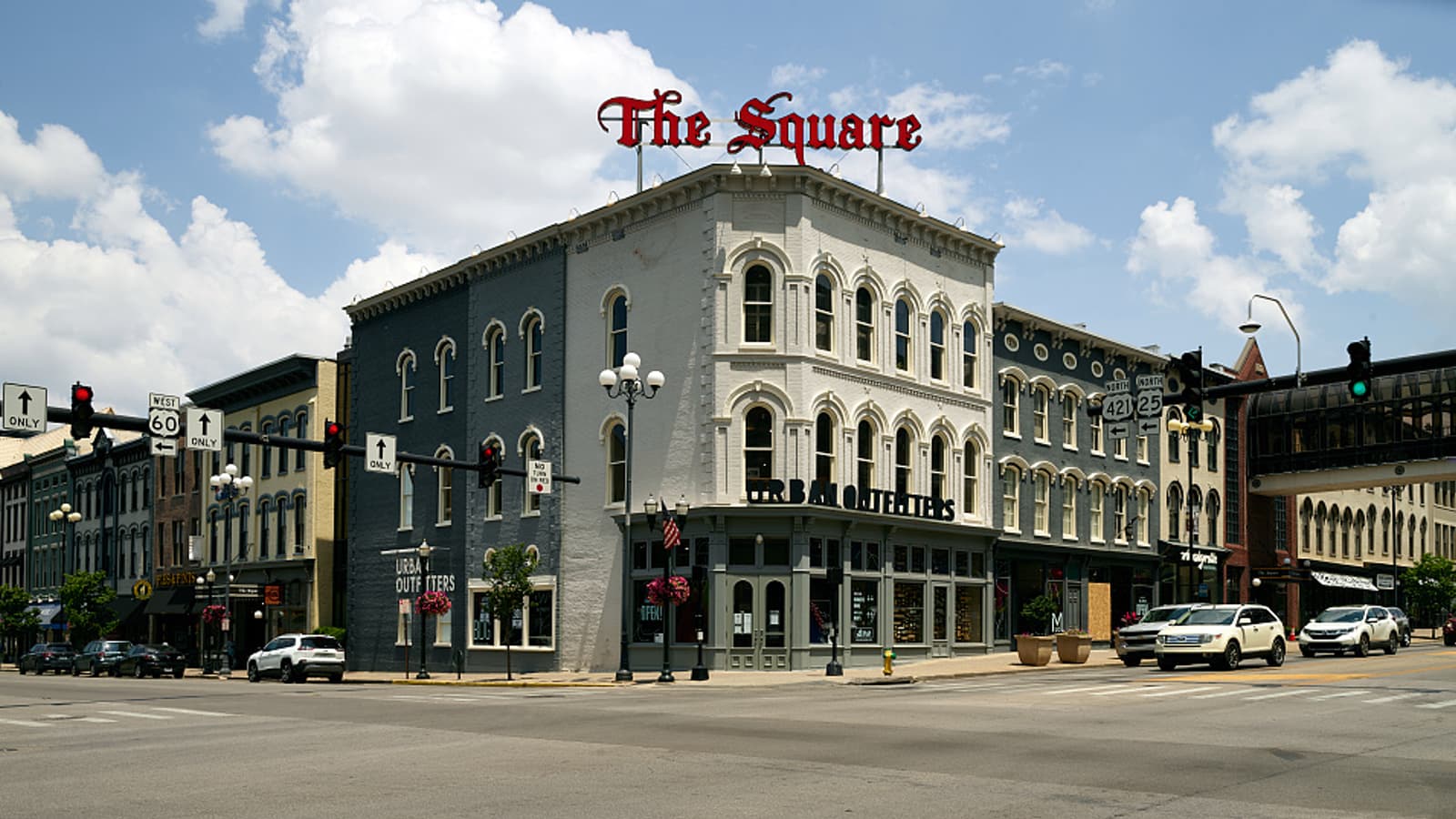
Fabled Fourths, No. 3 — real stories of Lexington’s Independence Days for America’s 250th, researched by Claude Fable 5, Anthropic’s newly released AI model. Fable’s vision is sharp enough to read the original newsprint — every quotation below was transcribed straight off the page scans, and every clipping is linked.
On June 26, 1910, readers who made it to the fourth section of the Sunday Lexington Herald found a full-page declaration of war on the Fourth of July as they knew it. “For a Safe and Sane Fourth,” the banner read. The subhead did not soften it: the “Present Celebration of Independence Day [is] More Deadly Than the Battles of the Revolution.”
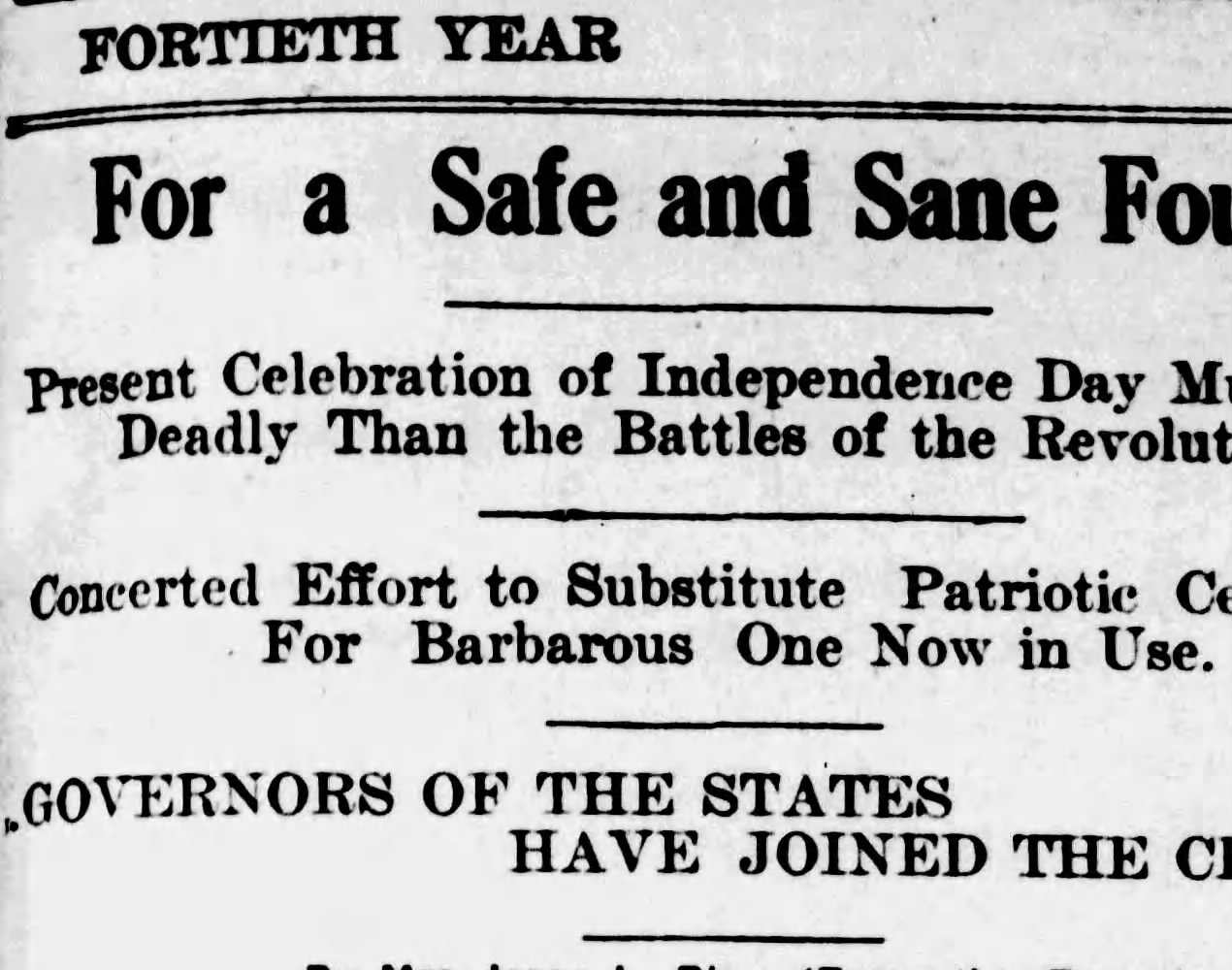
The piece, by the New York reformer Mrs. Isaac L. Rice, was the manifesto of a national movement, and the Herald gave it a section front. “The question of putting an end to the barbarity of our present observance of Independence Day is now assuming an importance undreamed of several years ago,” she wrote. “No longer need one fear to be branded with the stigma of disloyalty to country if one inveighs against the madness of parents who place dangerous explosives in the hands of their little ones.” The governors of the states, another deck announced, had joined the crusade; the goal was “a concerted effort to substitute [a] patriotic celebration for [the] barbarous one now in use.”
It sounds like temperance-committee hysteria until you see the arithmetic the movement was built on. Turn-of-the-century Fourths ran on unregulated gunpowder — toy cannons, giant crackers, blank pistols — and the annual casualty lists ran to thousands nationally, with tetanus (“patriotic lockjaw,” the papers called it) finishing what the explosions started.
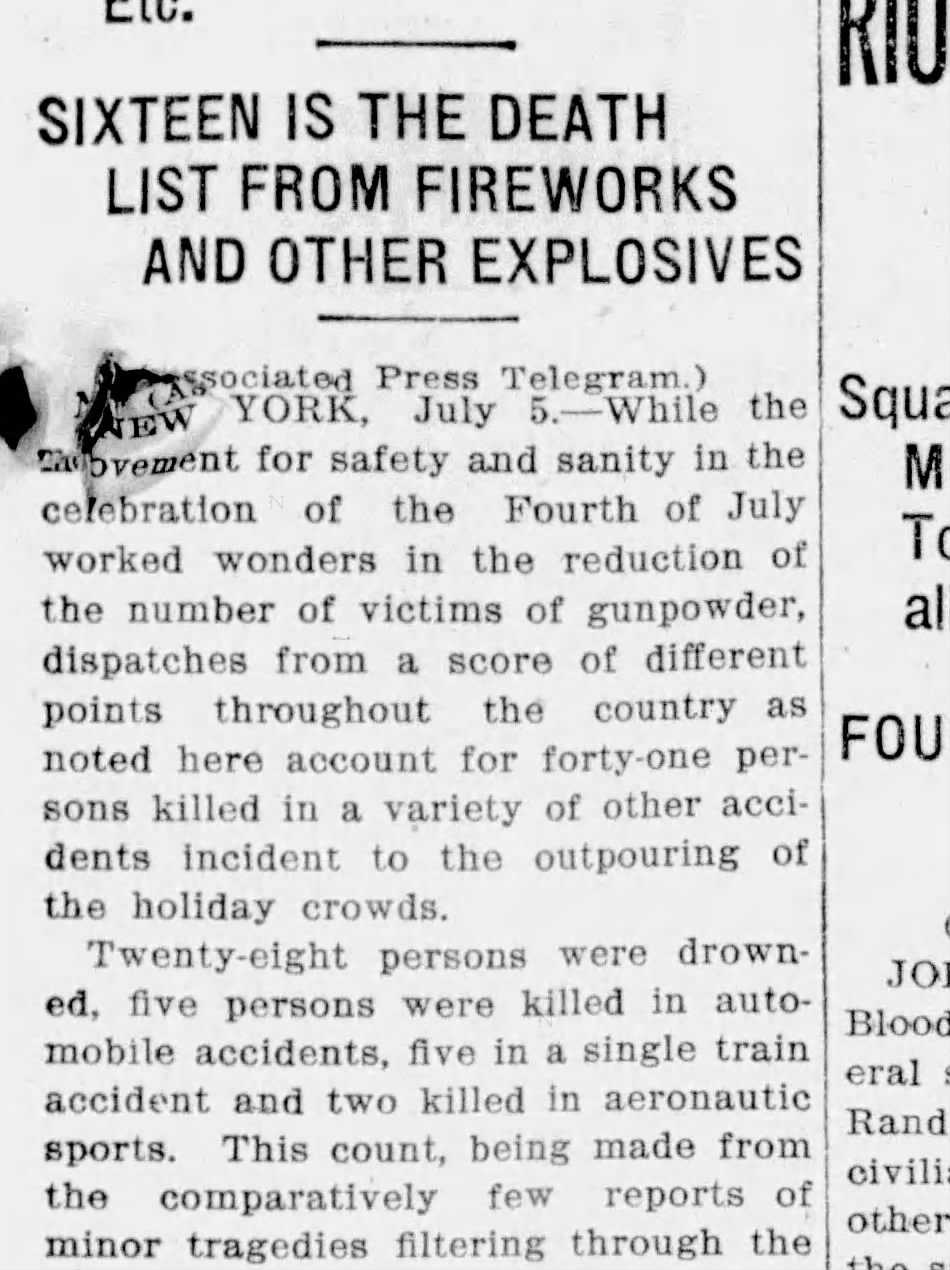
The crusade worked, sort of. “While the movement for safety and sanity in the celebration of the Fourth of July worked wonders in the reduction of the number of victims of gunpowder,” the Associated Press reported on the Herald-Leader’s front page of July 5, 1913, “dispatches from a score of different points throughout the country as noted here account for forty-one persons killed in a variety of other accidents incident to the outpouring of the holiday crowds.” Sixteen died of fireworks that year. But twenty-eight drowned, five died in automobiles, five in a single train wreck, and two in “aeronautic sports.” America had made the explosives safer; the holiday crowd had simply found new ways.
Then the war came and settled the argument. By 1918 the Fourth needed no manufactured thunder — Lexington’s sons were in France making the real kind. That summer’s celebration ran on Liberty Loan honor flags and military hardware: Frankfort’s big regional fete secured, via a wire from Senator J. C. W. Beckham, “an aviator from the Wright Aviation Camp in Ohio,” and the Herald noted that “Lexington is going to send down a brass band with her delegation.”
The phrase outlived the crusade. “Safe and sane” became the standing adjective for every municipal fireworks display of the next century — including the professionally fired, city-permitted shows Lexington will watch this weekend, 116 years after the Herald told its readers the old way was deadlier than Bunker Hill.
Sources
- The Lexington Herald, June 26, 1910, sec. 4, p. 19 — “For a Safe and Sane Fourth”
- Lexington Herald-Leader, July 5, 1913, p. 1 — “Sixteen Is the Death List From Fireworks”
- The Lexington Herald, June 29, 1918, p. 3 — Wright Camp aviator; Lexington’s brass band
- The Lexington Herald, July 5, 1918, p. 1 — the wartime Fourth’s front page
All quotations are transcribed from the original newsprint by Claude Fable 5.
Republishing: This is original Lexington Times reporting, licensed under Creative Commons CC BY-ND 4.0. You may republish this article, in full and unaltered, for free — including commercially — with credit to The Lexington Times and a link to the original.