🌎 Resumen en español · traducción automática
Jim Gray, secretario de transporte del gobernador Andy Beshear, es presidente de Gray Inc., una empresa constructora que ocupa el lugar 15 entre contratistas de telecomunicaciones según Engineering News-Record, y está trabajando en el campus PowerHouse, el primer centro de datos de hiperescala de Kentucky en Louisville. Aunque las redes sociales afirman que Beshear ha sido complaciente con los centros de datos por esta conexión, el registro público muestra que el gobernador vetó la primera exención fiscal para centros de datos en 2021, exigió que paguen su propia energía en junio, y firmó la primera orden ejecutiva sobre centros de datos en agosto, después de que Gray se separara de la administración en julio. Sin embargo, dos exenciones fiscales para centros de datos se convirtieron en ley sin la firma de Beshear mientras Gray era secretario de transporte, y Gray y sus asociados han donado aproximadamente 44,600 dólares a las campañas políticas de Beshear desde 2018.
Traducción y resumen generados por IA a partir del artículo en inglés. Puede contener errores; consulte el texto original.
LEXINGTON, Ky. — A claim making the rounds on social media says Gov. Andy Beshear has gone easy on data centers because Jim Gray, his longtime transportation secretary, chairs a Lexington construction company that builds them across the country.
Half of that is true. Gray Inc. says it ranks No. 15 among telecommunications contractors, the category that includes data centers, on Engineering News-Record’s 2026 list, and Jim Gray is still its chairman. The other half does not match the public record. Beshear vetoed Kentucky’s first data-center tax break in 2021. He said in June, while Gray was still in his administration, that any data center in Kentucky would have to pay for all of its own power. And on Aug. 6 he signed the state’s first executive order on data centers, three weeks after the July 15 separation date Gray gave on his ethics filing.
The record does show things the claim misses. Gray Inc. is working on the PowerHouse campus in Louisville, Kentucky’s first hyperscale data center, the company told the Times on Tuesday. That project relies on a 2024 tax break, limited to Jefferson County, that became law without Beshear’s signature while Gray was his transportation secretary. Beshear let a second, statewide tax break become law the same way in 2025. He has not called for a ban. And Gray, his relatives and people who work for his company have given Beshear’s campaigns and political committee about $44,600 since 2018, according to state and federal filings.
Gray Inc. says neither Jim Gray nor anyone at the company has ever had “involvement with the Governor or administration officials in shaping or informing data center policy.” The governor’s office says his approach to data centers is “not in the interest of any private individuals or businesses.”
Here is what The Lexington Times found.
The company
Gray Inc. was founded in Glasgow in 1960 and has been headquartered in Lexington since 1988. The family-owned firm designs and builds factories, food plants, distribution centers and, increasingly, data centers.
The company says on its website that it has completed more than 45 data centers and built more than 1,900 megawatts of new data-center capacity. In a September 2025 news release it said it was building 22 data centers at once. Engineering News-Record, the construction industry’s trade magazine, ranked Gray No. 30 among the country’s 400 largest contractors in its 2026 rankings. Gray says the same rankings placed it No. 15 among telecommunications contractors, the category that covers data centers. The magazine had earlier named a Gray-built Amazon Web Services campus in Mississippi one of the Southeast’s top project starts of 2024.
One of those projects is in Kentucky. “Gray is working with PowerHouse Data Centers and Poe companies on a data center project in Louisville,” the company said in a written response to the Times on Tuesday, sent by Abby Johnson, its vice president of marketing. PowerHouse and Poe announced the campus in January 2025 as Kentucky’s first hyperscale data center, on Camp Ground Road near the Cane Run power plant, with the first 130 megawatts due to come online in October 2026. The Times found no public announcement naming Gray as a builder on the project. The company pointed to an Aug. 5 post on LinkedIn in which PowerHouse thanked “Gray Construction” for a backpack drive for Louisville students that PowerHouse and Poe had joined. The post does not mention the data center. Asked when it was hired, what its scope is and whether the work was under way while Jim Gray was secretary, the company said only: “As with many of Gray’s customers, like PowerHouse, these engagements occur over multiple years.” It said it does not comment on “confidential business discussions or other potential opportunities.” Of the LinkedIn post, it said: “To our knowledge, the social post is the only external reference to the project.” Gray’s largest recent Kentucky project on the public record is the BlueOval SK battery park in Glendale, which it built with Barton Malow and which the state backed with a $250 million forgivable loan.
Jim Gray ran the company until he took office as mayor of Lexington in January 2011. He is listed as chairman of the board on the company’s website and as an officer and director of Gray Inc. on the annual report the company filed with the Kentucky secretary of state on June 15, 2026. His niece, Rebekah Gray, became chief executive of Gray Construction on Aug. 15, 2025. His brother Stephen Gray is president of the parent company. Gray says it is about 30% employee-owned through an employee stock ownership plan, with the Gray family holding the majority.
The secretary
Beshear named Gray transportation secretary on Dec. 2, 2019, eight days before taking office. Gray held the job until April 14, 2026, when Beshear announced he was shifting him to a part-time role as special adviser on transportation and moving Energy and Environment Cabinet Secretary Rebecca Goodman to the Transportation Cabinet. Gray served as special adviser “until his July 15, 2026, resignation, and assisted in Secretary Goodman’s transition into her role,” Scottie Ellis, the governor’s communications director, said in a statement Tuesday. The office did not answer whether the post was paid. The state’s public salary database lists no salary for Gray.
Gray’s tie to the company was disclosed from the start. The Herald-Leader reported the day of the appointment that Gray was board chairman of Gray Construction and had been an adviser to the company’s board as mayor. Beshear spokeswoman Crystal Staley told the paper he would keep the same type of relationship with the company as secretary.
Kentucky’s ethics law for executive-branch officials does not bar a cabinet secretary from owning or chairing a family business. It bars using the office to benefit the business, and it bars a business in which the official holds more than a 5% interest from contracting with the agency the official runs. For Gray that agency was the Transportation Cabinet, which builds roads and bridges, not data centers. The state’s vendor payment records for fiscal 2020 through 2027 list no payments to Gray Inc., Gray Construction or their affiliates. Those records would not show work Gray did as a subcontractor to another firm.
Gray’s ethics filing gives a later end date than the governor’s announcement. On the statement he filed with the Executive Branch Ethics Commission after leaving, he listed his position as “Secretary of Transportation,” with a start date of Dec. 10, 2019 and an ending date of July 15, 2026, and answered “None” to current employer and to other state jobs. He signed it Aug. 14. “As of July 2026, Jim Gray has no employment role with the administration,” the company said.
What his ethics filings show
Cabinet officers must file annual financial disclosure statements with the ethics commission. The statements are public but are not posted online. The Times requested Gray’s at 9:19 a.m. Friday and had them 37 minutes later: nine statements covering his appointment in December 2019 through his departure, with his home address, personal phone numbers and email addresses redacted.
They answer the ownership question. On every statement from December 2019 through 2026, Gray listed himself as non-executive chairman of the board of Gray Inc. and listed an ownership interest in the company. From the 2020 form on he described the stake as at least 5%; since the 2023 form the entry reads “Gray, Inc. and subsidiaries.” Every year he listed Gray Inc. as a source of more than $1,000 in income, identified as dividends on every form from 2020 on, and every year he listed Gray Inc. under “other employers” alongside the state. He also reported rent from Gray Realty LLC, a commercial real estate company at the same 10 Quality St. address as Gray Inc.’s headquarters, in which he holds at least a 5% stake, and he lists the 10 Quality St. property itself among his real-estate holdings.
The rest of his portfolio, as disclosed, is farmland near Glasgow, Lexington real estate companies, a residential rental unit on East High Street, bank and brokerage accounts, horse-sale proceeds from Airdrie Stud, and stakes worth more than $10,000 in a food-and-beverage startup, a hospitality group and an electric-boat maker. Apart from Gray Inc., which builds data centers for clients, nothing in the filings identifies any of those businesses as a data-center developer, operator or landowner.
Each year he answered “None” to whether he or a spouse had been paid to represent anyone before his own agency or any state body where he was a decision-maker, “None” to gifts worth more than $200 from anyone outside his family, and “No” to whether he was aware of any business opportunity offered to him or his family “in return for favorable treatment” from state government.
The file shows two housekeeping episodes. His first annual statement reached the commission in June 2020, after a paralegal’s reminder that it was overdue; his bookkeeper replied that she had mailed a copy in January and had since prepared an amended version adding equine investment income. His departure statement carried the wrong filing year, 2025, and the commission’s coordinator emailed him twice before he confirmed on Sept. 3 that it covered 2026.
Who decides on data centers
The claim assumes the transportation secretary has a hand in data-center policy. Under Kentucky law, he does not.
The state’s data-center tax break is a sales-tax exemption on computer equipment that can run for up to 50 years. A company gets it by signing an agreement with the Kentucky Economic Development Finance Authority, a board staffed by the Cabinet for Economic Development. Electric rates are set by the Public Service Commission. Environmental permits come from the Energy and Environment Cabinet. Where a data center can be built is a local zoning question, which is why Fayette County, Mercer County, Louisville and Woodford County have each acted on their own.
Beshear’s Aug. 6 executive order directs the Public Service Commission and the Energy and Environment Cabinet. It does not mention the Transportation Cabinet.
What Beshear has done
The governor’s record on data centers runs five years. It began with a veto.
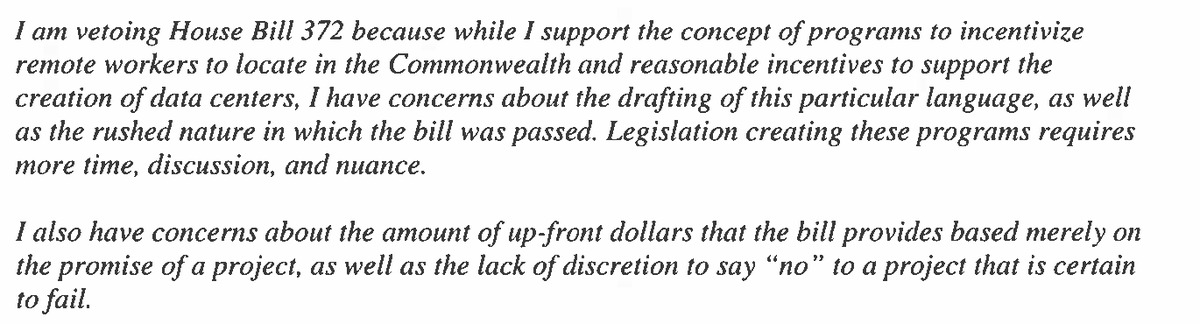
April 9, 2021. The legislature sent Beshear House Bill 372, the state’s first data-center sales-tax exemption. He vetoed it in full. “While I support the concept of … reasonable incentives to support the creation of data centers, I have concerns about the drafting of this particular language, as well as the rushed nature in which the bill was passed,” he wrote. He also cited “the lack of discretion to say ‘no’ to a project that is certain to fail.” The legislature had adjourned, so the veto stood.
April 10, 2024. A data-center exemption the Republican-controlled legislature had passed on March 28 as part of House Bill 8, a broad tax bill, became law without Beshear’s signature. It applied only to Jefferson County and lasted 50 years. Beshear had issued line-item vetoes on two other parts of the bill, a gold-bullion tax exemption and a tax-amnesty mandate. Senate President Robert Stivers, R-Manchester, later credited Beshear’s own Cabinet for Economic Development with helping craft the data-center language.
March 27, 2025. House Bill 775 expanded the exemption to all 120 counties, with a $450 million investment threshold in large counties and a $25 million threshold in the smallest. Beshear again let it become law without his signature. His public objection at the time, WKRN reported, was that the bill’s income-tax provisions were a “bait-and-switch,” not the data-center break. Google and Meta lobbied for the bill, WDRB reported, citing state lobbying records.
March 4, 2026. The House passed House Bill 593, which would have required data centers to pay for their own power and infrastructure, 90-8. The Senate never voted on it. The Times found no record of Beshear publicly pushing the bill during the session.
June 2, 2026. With communities including Mercer County pushing back on proposed data centers, Beshear was asked about them by reporters and drew a hard line. “Any data center that wants to look at Kentucky is going to have to pay for 100% of its own energy, and if it needs new means of production, it needs to pay for those too,” he said. He also said a data center “could double the budget of many of our public school systems,” WTVQ reported.
July 30, 2026. After the Trump administration announced a $100 billion data-center and gas-plant campus at the former Paducah Gaseous Diffusion Plant, Beshear’s office said he had not been briefed by any of the companies or agencies involved. The Department of Energy said it had notified his office twice.
Aug. 6, 2026. Beshear signed Executive Order 2026-494. It tells the Public Service Commission not to let a utility raise other customers’ rates to cover a data center’s costs, tells the Energy and Environment Cabinet to deny permits to data centers that would harm air, water or wetlands, and requires developers to file an energy plan and pay their “full and fair share” of state and local taxes. “If you cannot meet it, you’re not coming to Kentucky,” he said. Stivers called the order “more political theater than public policy.”
Aug. 27, 2026. Beshear went further than the order and called for repealing the tax break he had let become law. “I don’t think data centers need incentives. I don’t think we should be providing them, and so I would certainly support rolling back any of that,” he said. “These are some of the wealthiest companies in human history. They can afford the construction.”
Sept. 8, 2026. The same day Woodford County adopted the state’s first permanent data-center ban, Beshear told reporters in Glasgow that developers “have got to be upfront and transparent” and that he had been pushing them to drop nondisclosure agreements. He stopped short of endorsing bans. “If one locality doesn’t want it, good, they shouldn’t have to have it,” he said, “but I’m not sure that each one should be able to make that judgment for the other.”
Where the claim has a point
Beshear has not said Kentucky should not have data centers. His position, from June onward, is that they are welcome if they pay their own way. Critics on both sides have noted the gap between that rhetoric and the tools he holds. Joseph Verruni, an energy policy fellow at the Bluegrass Institute, a free-market think tank, put it this way in a Kentucky Lantern column in July: “A pledge to the governor is not a tariff.” The Kentucky Resources Council said after the executive order that state agencies “are creatures of statute and their authority and discretion are bound and limited by law.”
The veto pen he used in 2021 stayed in the drawer in 2024 and 2025. When Louisville’s first hyperscale campus was announced in January 2025, the utility LG&E credited “the legislature and Governor Beshear for passing the enabling legislation that puts Kentucky on the data center map.” That legislation was House Bill 8, the Jefferson County-only exemption Beshear let become law nine months earlier, while Gray sat in his cabinet. Gray Inc. now has a role on that campus, by its own account. The Kentucky Economic Development Finance Authority had not awarded the campus, or any other project, the exemption as of its Sept. 24 meeting. The Kentucky Center for Economic Policy estimated in July that four proposed projects alone could cost the state $1.2 billion to $2.2 billion in sales tax.
There is also money. Gray gave Beshear’s two campaigns for governor $8,100 between December 2018 and June 2023, according to the Kentucky Registry of Election Finance. Two of those checks, $2,000 in January 2022 and $2,100 in June 2023, were filed while he was a sitting cabinet secretary. His brothers Howard and Stephen Gray gave $4,000. Three other donors named Gray, one a Gray Construction architect and two who list the same home addresses as Howard and the architect, gave $10,000. Eleven employees and executives of Gray and its architecture affiliate, including the company’s general counsel and its communications director, gave $9,650. All of it was within legal limits.
Federal filings show Gray gave Beshear’s federal political committee, In This Together PAC, $5,000 on Feb. 21, 2024. The committee also reported $7,847.50 in in-kind travel from Gray on Aug. 1, 2024, booked to the account it uses for independent spending, with his employer listed as “Commonwealth of Kentucky” and his occupation as “Secretary.” The filing does not say what the travel was. Both gifts were legal and disclosed. Kentucky’s executive-branch ethics code restricts what officials may accept and bars campaign work on state time, but it does not address an official giving to the governor’s political committee. Gray is a major Democratic donor in his own right. He gave $100,000 to a Democratic National Committee joint fundraising fund in the fall of 2023, the Kentucky Lantern reported. The committee’s largest data-center-linked donor is not Gray but the electrical workers’ union: International Brotherhood of Electrical Workers committees gave In This Together $206,000 between September 2025 and July 2026, the Kentucky Lantern reported in August. The union supports data centers because they employ large numbers of electricians.
Beshear has praised the company in public. On July 19, 2024, during a trade mission to Japan, he posted on Facebook: “Gray Construction has been a long-time partner in Kentucky, including economic endeavors like the BlueOval SK and Lotte Aluminium facilities. While in Tokyo, we visited Gray’s Japan headquarters to share our appreciation!”
None of that is evidence that Gray shaped the governor’s data-center decisions, and the Times found none. No newspaper, radio station or public-records production reviewed for this story links Gray or his company to Beshear’s data-center policy. Both Gray Inc. and the governor’s office deny it. The Times could not locate the original social-media post.
What they said
The Times sent written questions to the governor’s office and to Gray Inc. on Friday morning, with a request that Gray Inc. forward Jim Gray’s questions to him. Both answered Tuesday afternoon, about a minute and a half apart, just before a 5 p.m. deadline. Gray answered a follow-up on the Louisville project at 6:38 p.m.
Gray Inc. answered for the company and for Jim Gray. It said he “disclosed his interest in Gray, Inc. and complied with the applicable financial disclosure requirements during his service in state government.” On whether he or the company had discussed data-center policy with the governor: “Neither in his former government capacity or in his private capacity has Jim Gray or any member of the Gray firm had involvement with the Governor or administration officials in shaping or informing data center policy.” The company said it “actively pursues opportunities in this market, including in Kentucky,” that “communities are right to ask questions about projects of this scale,” and that data centers “are an open door to a new technological market that Kentucky hasn’t currently capitalized on.”
Ellis, for the governor, said: “The Governor has been clear and direct when it comes to data centers, taking executive action to ensure any potential projects do not negatively impact Kentuckians, utility rates or the environment, and requiring data center project developers and operators to pay their fair share of taxes, while at the same time keeping these decisions exactly where they belong.” Those decisions belong, she said, “with the local citizens and communities that stand to be impacted.” She added: “The Governor’s approach to data centers is based on what he believes serves the best interests of the commonwealth.” It is, she said, “not in the interest of any private individuals or businesses.”
Neither would say what the $7,847.50 of in-kind travel was. Both said the question should go to the political committee. The governor’s office did not answer whether Gray had been present for any data-center discussion, whether he signed a recusal agreement, whether his adviser post was paid, or when it began.
The Lexington fight is on a separate track
Lexington’s council adopted a moratorium on data-center applications on June 9 by a 15-0 vote. The Planning Commission voted 7-2 on July 30 to recommend rules that would bar large data centers. The council will hold a special hearing on those rules at 5:30 p.m. Oct. 6, with public comment, and the moratorium lapses Oct. 31.
The Times searched every recorded council, committee and Planning Commission discussion of data centers since June. None mentioned the governor, his executive order, the state tax break or Gray Inc. The local record and the Frankfort record do not touch.
The governor who vetoed the first data-center tax break let the next two pass without his name on them. The order he signed in August does not mention the cabinet Gray ran. The company Gray chairs is now working on a data-center campus in the one county the first of those laws covered.
Sources: Kentucky Legislative Research Commission records for HB 372 (2021), HB 8 (2024), HB 775 (2025) and HB 593 (2026), including the governor’s April 9, 2021 veto message; Executive Order 2026-494, Aug. 6, 2026; Kentucky Revised Statutes 11A.020, 11A.040, 11A.050 and 154.20-220 through 154.20-229; Executive Branch Ethics Commission; Kentucky Secretary of State annual reports for Gray Inc. and Gray Construction Inc., filed June 15, 2026; Executive Branch Ethics Commission, Statements of Financial Disclosure for James P. Gray II (new hire, Dec. 10, 2019; annual, calendar years 2019 through 2025; leaver, signed Aug. 14, 2026), produced Sept. 25, 2026; Kentucky Registry of Election Finance contributor exports for the 2019 and 2023 gubernatorial elections; Federal Election Commission Schedule A filings for In This Together PAC; gray.com; Engineering News-Record; Governor’s Office news release, April 14, 2026; Lexington Herald-Leader, Dec. 2, 2019; WUKY, June 3 and Aug. 6, 2026; WTVQ, June 3, 2026; WKRN, March 26, 2025; Kentucky Public Radio, Aug. 27, 2026; Bowling Green Daily News, Sept. 10, 2026; WKYT, Sept. 11, 2026; Kentucky Lantern, July 2 and Aug. 24, 2026; LG&E news release, Jan. 16, 2025; Kentucky Center for Economic Policy, July 23, 2026; LFUCG meeting archive clips 6797, 6843 and 6876; Gov. Andy Beshear Facebook page, July 19, 2024; written responses to The Lexington Times from Gray Inc. (Abby Johnson, vice president of marketing) and the Office of the Governor (Scottie Ellis, communications director), Sept. 29, 2026; PowerHouse Data Centers and Poe Companies news release, Jan. 16, 2025; WDRB, Jan. 2, 2025; PowerHouse Data Centers on LinkedIn, Aug. 5, 2026.
Sources
- Kentucky LRC — HB 372 (2021 RS), vetoed April 9, 2021
- Gov. Beshear veto message on HB 372, April 9, 2021 (PDF)
- Kentucky LRC — HB 8 (2024 RS), became law without governor’s signature April 10, 2024
- Kentucky LRC — HB 775 (2025 RS), became law without governor’s signature March 27, 2025
- Kentucky LRC — HB 593 (2026 RS), passed House 90-8 March 4, 2026
- Executive Order 2026-494, Aug. 6, 2026 (PDF)
- KRS 11A.040 — Executive Branch Code of Ethics, acts prohibited
- KRS 11A.020 — Executive Branch Code of Ethics, public servant’s duties
- KRS 154.20-220 et seq. — Qualified data center incentives (KEDFA)
- Executive Branch Ethics Commission — Statements of Financial Disclosure, James P. Gray II, 2019–2026 (produced to The Lexington Times Sept. 25, 2026)
- Office of the Governor, April 14, 2026 — cabinet changes (Gray to Special Advisor on Transportation)
- Kentucky Secretary of State — Gray, Inc. (Org. 0156781), annual report June 15, 2026
- Gray — data center market page (45+ completed, 1,900 MW+)
- Gray — Jim Gray, Chairman of the Board
- Gray news release, July 11, 2025 — Rebekah Gray named CEO of Gray Construction effective Aug. 15, 2025
- Lane Report, June 2026 — ENR ranks Gray No. 30 overall, No. 15 telecommunications
- ENR, Feb. 17, 2022 — Ford picks Barton Malow and Gray for BlueOval SK
- Lexington Herald-Leader, Dec. 2, 2019 — Beshear picks Jim Gray as transportation secretary
- Kentucky Registry of Election Finance — contributor exports, 2019 and 2023 gubernatorial elections
- FEC — In This Together PAC (C00864785) receipts from Gray
- FEC filing FEC-1817948, Schedule A line 17 — $7,847.50 in-kind travel, Aug. 1, 2024
- Kentucky OpenDoor — vendor payment search
- WUKY, June 3, 2026 — Beshear vows no extra costs for ratepayers
- WTVQ, June 3, 2026 — Beshear urges skepticism and open-mindedness on data centers
- WKYT, July 31, 2026 — Beshear says he was uninformed about Paducah data center
- E&E News, Aug. 13, 2026 — ‘I was not briefed’
- Kentucky Public Radio (Joe Sonka), Aug. 27, 2026 — Beshear calls for ending data-center tax incentives
- Bowling Green Daily News, Sept. 8, 2026 — Governor talks data centers, health care
- Kentucky Lantern (Joseph Verruni), July 2, 2026 — Beshear’s instincts on data centers are good but his tools are few
- Kentucky Resources Council statement on EO 2026-494, Aug. 6, 2026
- LG&E news release, Jan. 16, 2025 — first major data center electric customer
- Kentucky Center for Economic Policy, July 23, 2026 — data center tax breaks
- WUKY, Sept. 9, 2026 — IBEW gives $206,000 to Beshear’s PAC
- WKRN, March 26, 2025 — Beshear’s bill actions (‘bait-and-switch’)
- WDRB — New Kentucky law lobbied by Google and Meta expands data-center tax breaks
- Gov. Andy Beshear on Facebook, July 19, 2024 — Gray Construction, Tokyo
- LFUCG meeting archive — Urban County Council, June 9, 2026 (moratorium, 15-0)
- LFUCG meeting archive — Planning Commission zoning items, July 30, 2026 (7-2)
- The Lexington Times, June 10, 2026 — Data center boom lifts Lexington-based Gray to top 15 contractors
- Written response to The Lexington Times from Gray Inc. (Abby Johnson), Sept. 29, 2026 — on file
- Written statement to The Lexington Times from the Office of the Governor (Scottie Ellis), Sept. 29, 2026 — on file
- PowerHouse Data Centers on LinkedIn, Aug. 5, 2026 — backpack drive with Gray Construction
- PowerHouse Data Centers and Poe Companies, Jan. 16, 2025 — Kentucky’s first hyperscale data center campus
- WDRB, Jan. 2, 2025 — Camp Ground Road data center plans
- Gray — careers/benefits page (approximately 30% employee-owned)
- The Lexington Times, Aug. 10, 2026 — The data center, the bourbon bar and the mugshot, explained
This article was reported and written with AI (claude-fable-5-1) by The Lexington Times newsroom from primary records: Kentucky Legislative Research Commission bill records and the governor’s 2021 veto message; Executive Order 2026-494; Kentucky Revised Statutes chapters 11A and 154; Kentucky Secretary of State annual reports for Gray Inc. and Gray Construction Inc.; Kentucky Registry of Election Finance contributor exports; Federal Election Commission filings for In This Together PAC; Kentucky OpenDoor vendor and salary data; the Executive Branch Ethics Commission’s published filing rules; the Governor’s Office news release of April 14, 2026; gray.com; and the LFUCG meeting archive. Quotations from the governor and legislators are taken from the cited news reports and the signed executive order. The Lexington Times could not locate the original social-media post. Gray’s ownership stake is taken from his Statements of Financial Disclosure, produced by the Executive Branch Ethics Commission on Sept. 25, 2026, and read from the page images.
Republishing: This is original Lexington Times reporting, licensed under Creative Commons CC BY-ND 4.0. You may republish this article, in full and unaltered, for free — including commercially — with credit to The Lexington Times and a link to the original.