LEXINGTON — Lexington’s vision for its downtown core and the future of historic rural settlements dominated discussion Tuesday as the Urban County Council’s General Government and Planning Committee advanced long-range planning efforts that could shape development decisions for decades.
The committee heard an extensive update on the city’s Downtown Area Master Plan — a yearlong, community-driven process — followed by a renewed look at Fayette County’s rural settlements, small historic communities that planners and council members say need clearer recognition and protection.
The meeting was held Tuesday afternoon at the Government Center.
Downtown plan emphasizes housing, walkability and community input
Planning staff told council members the Downtown Area Master Plan is moving into its development phase after months of data analysis and public engagement.
Principal planner Boyd Sewe said the process, which began last summer, has included large public workshops, targeted outreach to students and neighborhood groups, and an online survey that drew significant participation from younger residents. According to planning materials, 27% of survey respondents were ages 18 to 24, and a majority of responses came from ZIP codes surrounding downtown.
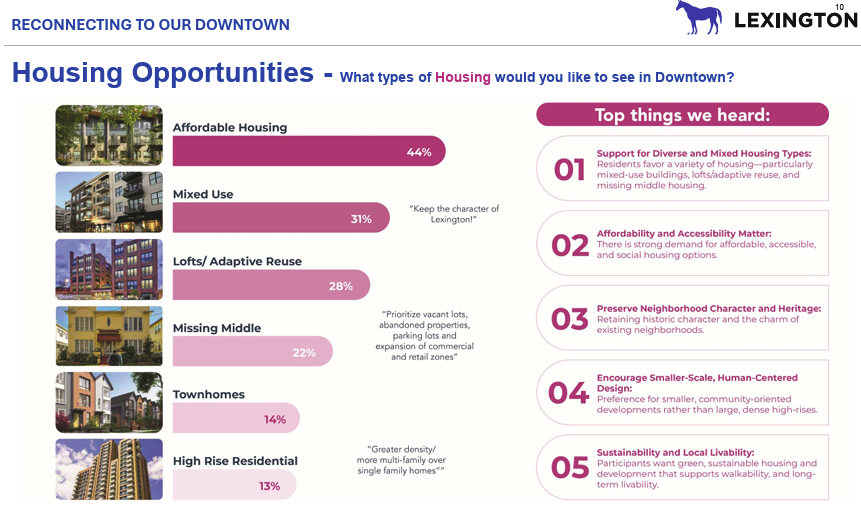
Housing affordability emerged as the most frequently cited concern. Survey results showed strong support for affordable housing, mixed-use development and adaptive reuse of existing buildings, alongside calls for neighborhood preservation and better pedestrian safety.
Residents also emphasized everyday retail needs, casual dining options, green infrastructure and safer streets — feedback that Sewe said closely aligns with goals already outlined in Lexington’s Comprehensive Plan.
A key element of the plan is defining what “downtown” means. Planners presented draft maps showing a downtown core, a central business district and a broader “area of influence” — a term that council members suggested could be renamed “midtown.” Staff stressed that the definition would guide future policy and investment decisions but would not change zoning or trigger immediate development.
Council members praised the level of public engagement but raised questions about affordability, displacement and whether the plan could eventually lead to structural changes such as a downtown development authority. Staff said more specific recommendations will come once the housing and market analysis is finalized.
A second communitywide meeting is scheduled for March 4 at Greyline.
Rural settlements study revived
The committee also received a presentation on Fayette County’s rural settlements — 16 small historic communities located outside the Urban Service Area — marking the first formal discussion of the issue in several years.
Planning Director Jim Duncan described rural settlements as residential or business communities established largely between the late 1800s and early 1900s, including Free Black settlements, crossroads communities and early rural subdivisions. Together, they total about 505 acres.
A 2006 study recommended tools such as historic overlays, signage, financial assistance for low-income homeowners and other measures to recognize and preserve these areas. Duncan said the study remains relevant and does not need to be redone, but rather used as a foundation for next steps.
Council members debated how preservation efforts could affect property owners, particularly if protections limit future development options. Others raised concerns about what happens when surrounding land urbanizes and whether rural settlements should receive special consideration during Urban Service Area expansion discussions.
Vice Chair Shayla Lynch said she plans to convene a work group to examine each settlement individually, noting that “there’s not going to be a cookie-cutter solution.” She framed the effort around four goals: preserve, protect, enhance and enable.
Several members emphasized the importance of engaging residents directly and documenting oral histories as part of the process.
Committee business
The committee also conducted its annual review of referred items, removing several completed or inactive topics, including a homelessness needs assessment and routine updates from the Lexington History Museum. Other long-term planning items — such as charter review, affordable housing strategies and solar energy regulations — remain in committee.
The General Government and Planning Committee meets next on Feb. 10.