🌎 Resumen en español · traducción automática
Lexington trazó el primer límite de crecimiento urbano de la nación en 1958, una línea que separaba el área urbana de las granjas de caballos rurales, pero sesenta y ocho años después esta línea se ha convertido en el centro de la política local con dos fuerzas económicas poderosas enfrentadas: los desarrolladores que quieren expandir la ciudad y los propietarios de granjas de caballos que quieren mantener sus tierras rurales. El voto de una concejal para expandir el límite de servicios urbanos en 2023, después de recibir donaciones de propietarios de granjas de caballos, resultó en que esos mismos donantes financiaran anuncios en su contra en 2024, ilustrando cómo el dinero de la preservación de tierras agrícolas controla la política local de Lexington. El límite urbano original de 1958 ha mantenido dos tercios del condado como tierra rural con requisitos mínimos de 40 acres por lote, lo que ha hecho que estas tierras sean enormemente valiosas y ha consolidado la marca de Lexington como la "Capital Mundial del Caballo".
Traducción y resumen generados por IA a partir del artículo en inglés. Puede contener errores; consulte el texto original.
Lexington drew the nation’s first urban growth boundary in 1958. Sixty-eight years later, the line on the map has become the line in local politics — and the two richest forces in town are lined up on opposite sides of it.
In 2022, Greg and Rebecca Goodman of Mt. Brilliant Farm each wrote Liz Sheehan a $2,000 check, the maximum an individual could give to her Fifth District council campaign.
In 2023, Sheehan voted to expand Lexington’s urban service boundary — the line that, for sixty-five years, had separated the city that could be built on from the horse farms that could not.
In 2024, a political committee funded overwhelmingly by horse-farm money — most of it the Goodmans’ — ran ads against her.
That is the whole story of Lexington land politics in three sentences: the preservation money backs you, you cross it on the one vote that matters, and the money turns around and aims at you. To understand why a council member’s vote on where to draw a line can flip six figures of campaign money from her column to her opponent’s, you have to understand the line itself — and the two armies that have formed along it.
The most valuable line in Kentucky
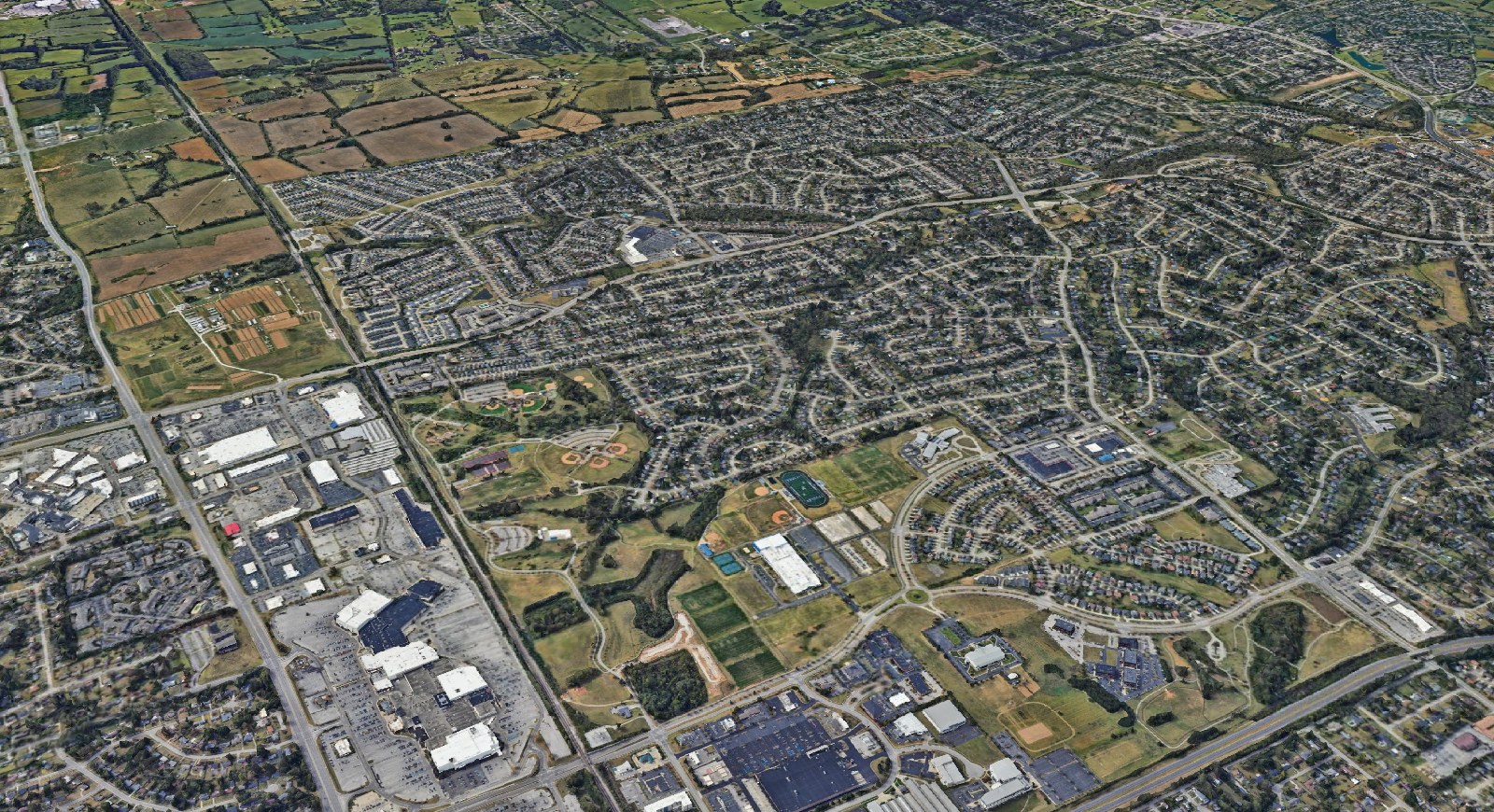
In 1958, Lexington and Fayette County drew an “urban service area”: inside it, the government would extend sewers, water, and roads and allow dense development; outside it, the land would stay rural. It is widely credited as the first urban growth boundary in the United States, and it is the reason a visitor can stand at the literal edge of a subdivision and look across a fence line at a thousand-acre stud farm. Today the land inside the line — less than a third of the county — holds about 97 percent of its people; the other two-thirds stays in farms and paddocks, held there by 40-acre minimum lot sizes.
The line did something unusual: it made rural land permanently rural, and in doing so it made that land enormously valuable as land — the paddocks and stone fences that built the “Horse Capital of the World” brand. In 2000 the city went further, creating a Purchase of Development Rights program — Kentucky’s first locally run agricultural conservation easement program — that pays farmers to give up their right to ever develop. It set a goal of protecting 50,000 acres; it has locked up more than 33,000 so far, across roughly 300 farms.
Most cities with growth boundaries treat them as living documents. Portland’s regional government has nudged its boundary outward more than thirty times since the 1970s, usually in small increments, on a six-year review cycle written into state law. Lexington did the opposite. For decades it held the line almost perfectly still, and treated any proposal to move it as a civic emergency.
Then, in 2023, it moved.
The vote
The fight came to a head in 2023, in the once-a-decade rewrite of the city’s comprehensive plan. In June, the council voted 10 to 3 to direct an expansion of between 2,700 and 5,000 acres — the first in a generation. The three no votes were Vice Mayor Dan Wu and council members Hannah LeGris and Dave Sevigny. Efforts to hold the number lower failed. That November, the Planning Commission adopted the actual map on a 6-to-4 vote: about 2,800 acres across five areas, out toward I-75 and Winchester Road and around Parkers Mill and Man o’ War.
The argument for moving the line was housing. A 2016 city study had concluded Lexington needed about 23,000 new housing units by 2025; only about 4,175 were built in that window. The median home price has risen roughly 57 percent since 2019, from about $175,000 to $274,000, and a starter home now runs close to $300,000. The expansion’s supporters — a council majority, the homebuilders, the Realtors — argued the city had simply run out of room, and that the prices were the proof.
The opponents argued the city had not done its homework: that it still had room to build inside the line and had not justified the expansion with data. That data argument did not stay inside the council chamber.
The preservation machine
The slow-growth side in Lexington is not a grassroots accident. It is organized, well-funded, and runs on two engines.
The first is Fayette Alliance, a 501(c)(4) land-use advocacy organization founded in 2006 — the kind of nonprofit that is allowed to spend on politics — with an affiliated 501(c)(3) foundation that does its research and education. It was co-founded by Greg Goodman, who has owned the roughly 1,200-acre Mt. Brilliant Farm on Russell Cave Road since 1996. Fayette Alliance does the white-paper work: research, education, and the argument that, in its telling, 72 percent of Lexingtonians oppose moving the boundary. After the 2023 decision, it did something more aggressive: it joined area residents in suing to block the expansion, arguing the city had violated the state requirement that comprehensive plans be “based on analysis, projections, and research.” The “you didn’t do the homework” dissent became a lawsuit.
The second engine is electoral. A committee called Protect Lex raised about $255,000 — and almost all of it came from the land it was protecting. Five members of the Goodman family put in roughly $110,000 of it, about 43 percent of everything the committee raised. Lisa Lourie of Spy Coast Farm gave $25,000; Richard Masson of Golden Age Farm gave $25,000; a short list of other farm names filled in most of the rest. Protect Lex spent that money on negative ads against Sheehan and fellow council member Brenda Monarrez — both of whom had voted for the expansion — built around the claim that it would cost Lexington up to $570 million in new infrastructure. (Expansion supporters called the figure misleading, noting that the great majority of any such cost would fall on the developers who build in the new areas, not on taxpayers.)
None of this is hidden, and none of it is illegal. It is also not, on its face, cynical: the Goodmans are genuine conservationists — Greg Goodman was honored with a land-conservation award in 2023 — and the case that Lexington’s farmland is its economy is a serious one. Kentucky’s equine industry generates an estimated $6.5 billion in annual economic activity and more than 60,000 jobs, and Fayette County holds about 89,000 acres of horse land, more than any other county in the state. The people who own that land have an enormous financial stake in keeping it rural. They also happen to be right that it is worth keeping.
The growth machine
The other army is just as organized, and its money is just as traceable — which is the part Lexington’s mainstream coverage has tended to leave out.
The single largest employer-source of money in Lexington’s local campaign filings is, improbably, a horse farm: contributions tied to Mt. Brilliant Farm total roughly $192,700, more than triple the next name on the list. That next name is Ball Homes, the city’s dominant homebuilder, at about $54,000 — and the Ball money moves in a tight, recognizable formation. Cycle after cycle, several members of the Ball family each write the $2,000 maximum to the same slate of at-large council members. Around them sit the rest of the development bloc: Anderson Communities, whose owner Dennis Anderson gives to nearly every member; the Greer, Setzer, Pulliam and Turner operations; Justice Real Estate; Walker Properties; and organized political committees like HOMEPAC — the political fund of the Building Industry Association of Central Kentucky — and the Kentucky Realtors PAC.
Here is the part that resists a tidy conspiracy: at the council level, most incumbents take money from both camps, and the money does not cleanly predict the vote. Several of the Goodmans’ own past beneficiaries voted to expand anyway, and the Realtors’ political committee helped fund two of the three members who voted no. What sorts the members is not who writes the checks — it is how they vote when the line is on the agenda. Sheehan took the Goodmans’ money in 2022, then HOMEPAC, Anderson Communities, a Ball, and the Realtors PAC as the lines hardened. Monarrez, attacked by Protect Lex for her “yes,” had actually pushed to make the expansion smaller, and still got hit for the final vote; she took builder and Realtor money and none from the Goodmans. Sheehan voted with the builders, and the farms came after her. She won anyway.
Frankfort, too
The fight does not stop at the city limits. Both sides keep registered lobbyists in the state capital, where the laws on annexation, zoning, and short-term rentals are written. The homebuilders and Realtors work the capitol through the Home Builders Association of Kentucky and the Kentucky Realtors, who share a single contract-lobbying firm. Fayette Alliance lobbies there too — it has registered every year since 2019, alongside groups like the Bluegrass Land Conservancy. In the 2026 session the two sides squared off over the same bills from opposite directions, including Senate Bill 9, an omnibus “housing districts” measure that would have let developers assemble large housing tracts and clawed back some local control, and which died on the session’s final day.
The hedging is visible even at the level of a single legislator. Both blocs max out to the same person: state Senator Amanda Bledsoe, whose district covers Lexington and who sits where annexation and land-use law gets written. The Goodmans and Mt. Brilliant gave her $4,400; Ball Homes gave her $2,000. Each side keeps a line open to the lawmaker most likely to shape the next version of this fight.
The exception that keeps it honest
If the money were a simple bribe-for-vote machine, Dan Wu would be the preservation movement’s hero — and for a while he looked the part. The Goodmans helped fund his 2022 council campaign, and he was one of the three members who voted against the expansion. Yet by 2026 the Goodman money had left him entirely and gone to Mayor Linda Gorton’s reelection, while Wu’s own campaign for mayor was being filled out by developer and homebuilder names.
The simplest honest reading is that the money does not track a single vote so much as a side — and that, in a contested mayoral race, the farms backed the incumbent who defends the status quo over the challenger who once voted their way. Wu is the reminder that these are alliances, not transactions, and that a person can vote against expansion and still end up funded by the people who want it. The pattern is real; it is not a machine.
What the line is for
Strip away the money and a genuine disagreement remains, and it is not one Lexington can resolve by deciding which donors it likes less.
The builders are not wrong that the line, eventually, raises the price of a house: hold the supply of land fixed while the population grows and something has to give. The economics are genuinely contested — one well-known study of Seattle’s boundary found it pushed land prices up 230 percent while actually nudging home prices slightly down, and estimates across the literature range from almost nothing to tens of thousands of dollars a house — but the long-run pressure is real, and Lexington’s price chart since 2019 is not nothing.
The preservationists are not wrong that the farmland is the irreplaceable asset, the thing that makes Lexington itself and not Louisville’s southern suburb. Once a paddock becomes a cul-de-sac, no comprehensive plan turns it back.
But Lexington is not the first place where wealthy landowners have funded the case for holding a line, and the cautionary examples cut in their direction. Boulder, Colorado — the first American city to tax itself, in 1967, to buy a greenbelt — now sits on more than 100,000 protected acres and some of the least affordable housing in the country. In Aspen, a cap of roughly 50 new homes a year, in place since 1979, helped produce a median home price near $4 million. In Marin County, the celebrated farmland trust that saved the landscape also, critics found, helped entrench wealthy gentleman-farmers and price out the working farmers it was meant to protect. The line keeps the land beautiful. It does not, on its own, keep it shared.
After the 2023 fight, the council tried to take some of the heat out of the next one. In February 2026 it unanimously adopted a new, deliberately data-driven process for any future expansion: a growth-trend report every five years, a hard look at infill and vacant land before any new ground is added, a formal window for landowner proposals. It is, in effect, the homework the dissenters and the lawsuit said was missing.
Whether it holds is already being tested. The current flashpoint is the Mint Lane pump station — a piece of city sewer infrastructure that opponents say would, for the first time, reach past the line, setting the precedent that lets the rest follow. It is a fight about a sewer pump. It is also, like everything else here, a fight about the line.
For sixty-eight years that line has done exactly what it was drawn to do: it has made some of the most valuable land in Kentucky permanently off-limits to the people who build houses, and permanently valuable to the people who keep horses. The two of them have been arguing about where to put it almost since the day it was drawn. The only thing that has changed is that now you can read the argument, dollar by dollar, in the campaign-finance reports.
Editor’s note: This piece draws on Kentucky Registry of Election Finance filings (via the Lexington Times donor dashboard and KREF Watch), Kentucky Legislative Ethics Commission lobbying records (via KLEC Watch), the LFUCG meeting and planning record (meetings.lexingtonky.news), CivicLex’s urban-service-boundary explainers, LFUCG planning and Purchase of Development Rights documents, Fayette Alliance materials, city and federal housing studies, the University of Kentucky equine survey, Portland Metro records, and published academic research on urban growth boundaries. Campaign-finance figures are aggregated from public KREF data and reflect filings available at publication. AI-assisted reporting, human-edited; analysis and conclusions are the Lexington Times’.
Sources
- Lexington Times Donors Dashboard — LFUCG 2022/2024/2026 KREF filings
- KREF Watch — statewide Kentucky campaign-finance database
- KLEC Watch — Kentucky Frankfort lobbying database
- CivicLex — “The Urban Service Boundary” (big-issues explainer)
- Fayette Alliance — “A Vote Against Smart Growth” (June 1, 2023 council roll call, 10–3)
- CivicLex — “Council approves new process for determining Urban Service Area expansion”
- Fayette Alliance
- LFUCG — Purchase of Development Rights program
- Kentucky Equine Education Project (KEEP)
- University of Kentucky — Kentucky equine industry economic impact (2022 Equine Survey)
- Oregon Metro — Portland-region Urban Growth Boundary
- University of Chicago — “Urban Growth Boundary inflates land prices, deflates housing prices in King County, WA”
- HUD — Lexington-Fayette, KY Comprehensive Housing Market Analysis
- The Lexington Times — “Editor’s Notebook: Where’s the Goodman story?”
- The Lexington Times — 15-day pre-primary filings: the Goodman bundle to Gorton
This analysis was reported and drafted with AI assistance (Claude Opus 4.8) and finalized for publication by The Lexington Times. The money figures are aggregated from public Kentucky Registry of Election Finance filings via the Lexington Times donor dashboard and KREF Watch, and Frankfort lobbying figures from Kentucky Legislative Ethics Commission records via KLEC Watch. The vote record, the 2023 urban-service-area expansion, the Protect Lex committee, the Fayette Alliance lawsuit, and the Mint Lane dispute are documented in the LFUCG meeting and planning record, CivicLex, and Fayette Alliance materials; national context draws on Oregon Metro, the University of Kentucky equine survey, and published academic research on urban growth boundaries. The piece is written to give both the preservation and the growth side their strongest public-interest case; the analysis and conclusions are the Lexington Times’. Campaign-finance totals reflect filings available at publication and may change as later reports are filed.
Republishing: This is original Lexington Times reporting, licensed under Creative Commons CC BY-ND 4.0. You may republish this article, in full and unaltered, for free — including commercially — with credit to The Lexington Times and a link to the original.