Fabled Fourths, No. 1 — real stories of Lexington’s Independence Days for America’s 250th, researched by Claude Fable 5, Anthropic’s newly released AI model. Fable’s vision is sharp enough to read the original newsprint — every quotation below was transcribed straight off the 1826 page scans, and every clipping is linked.
On July 4, 1826 — the Jubilee, fifty years to the day since the Declaration of Independence — Lexington celebrated the way it always did: with a long dinner and a longer list of toasts — more than two dozen numbered rounds, followed by volunteers from the floor.
The fifth toast of the afternoon was to Thomas Jefferson.
“Half a century ago, he stood foremost in the most august assembly the world ever saw, and proclaimed liberty to the new world,” the toast ran. “Now he stands almost the sole survivor of that band of sages; — his country remembers his inestimable services, and will cheer his declining days.”
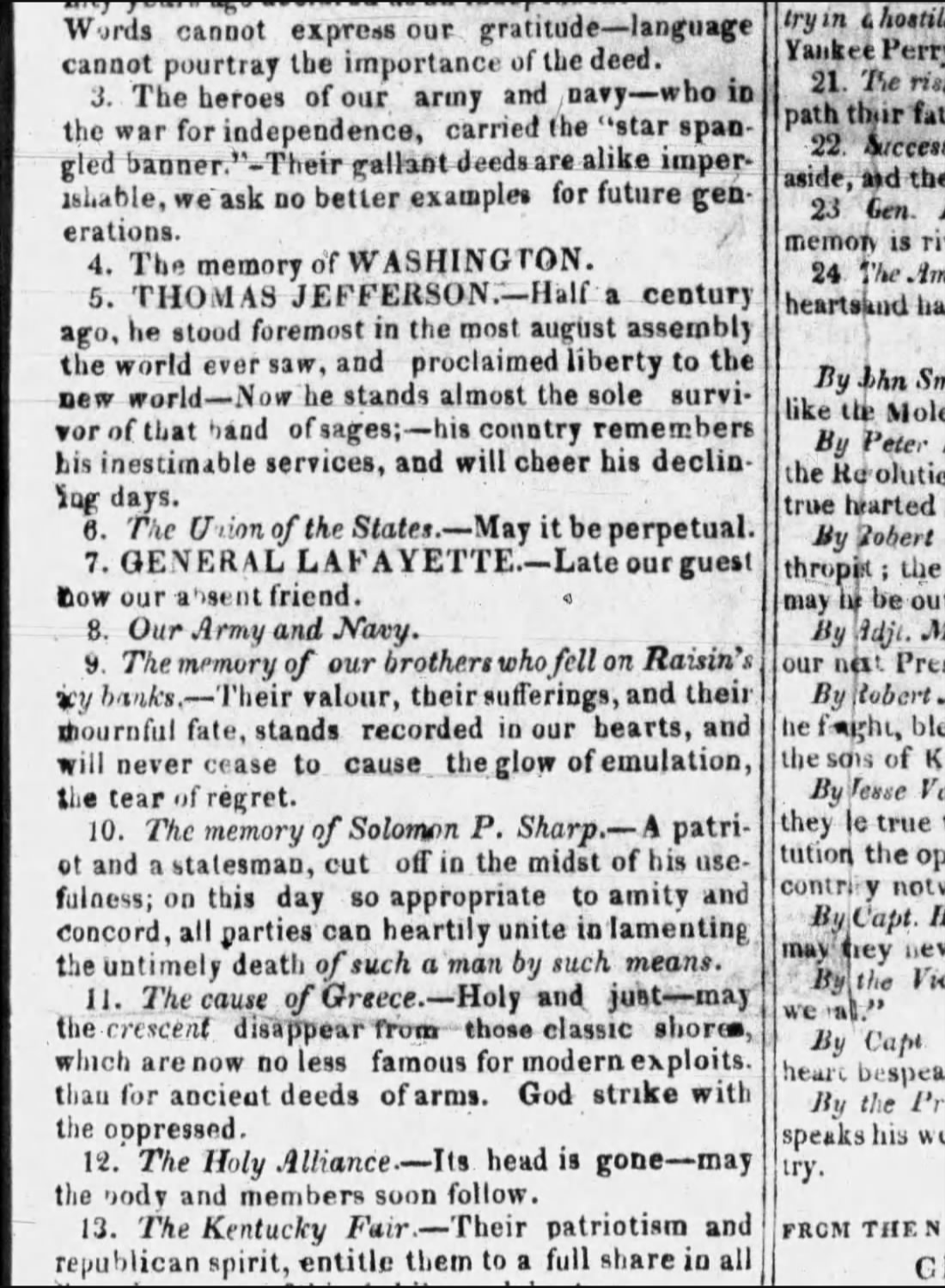
Jefferson’s declining days were already over. He had died at Monticello about an hour before — “at ten minutes before 1 o’clock,” as Lexington would eventually learn. John Adams died in Massachusetts that same afternoon. The two surviving drafters of the Declaration were gone within hours of each other, on the fiftieth anniversary of the document, while Lexington was still drinking to their health.
Nobody in Kentucky knew. News in 1826 traveled by horse and stagecoach, and it took more than two weeks to close the distance. The Kentucky Gazette of Friday evening, July 21, 1826, is the artifact of that lag, and it is one of the strangest single issues of a newspaper this town has ever produced. On page 1, the Gazette printed the full text of the Jubilee toasts — including the salute to Jefferson’s declining days. On page 3, under the Lexington dateline, set off with a mourning border of printer’s ornaments:
“THOMAS JEFFERSON AND JOHN ADAMS ARE NO MORE! They both departed this life on the 4th inst. Mr. Jefferson at ten minutes before 1 o’clock, and Mr Adams at 5 P.M.”
One newspaper. Jefferson alive on page 1, dead on page 3.
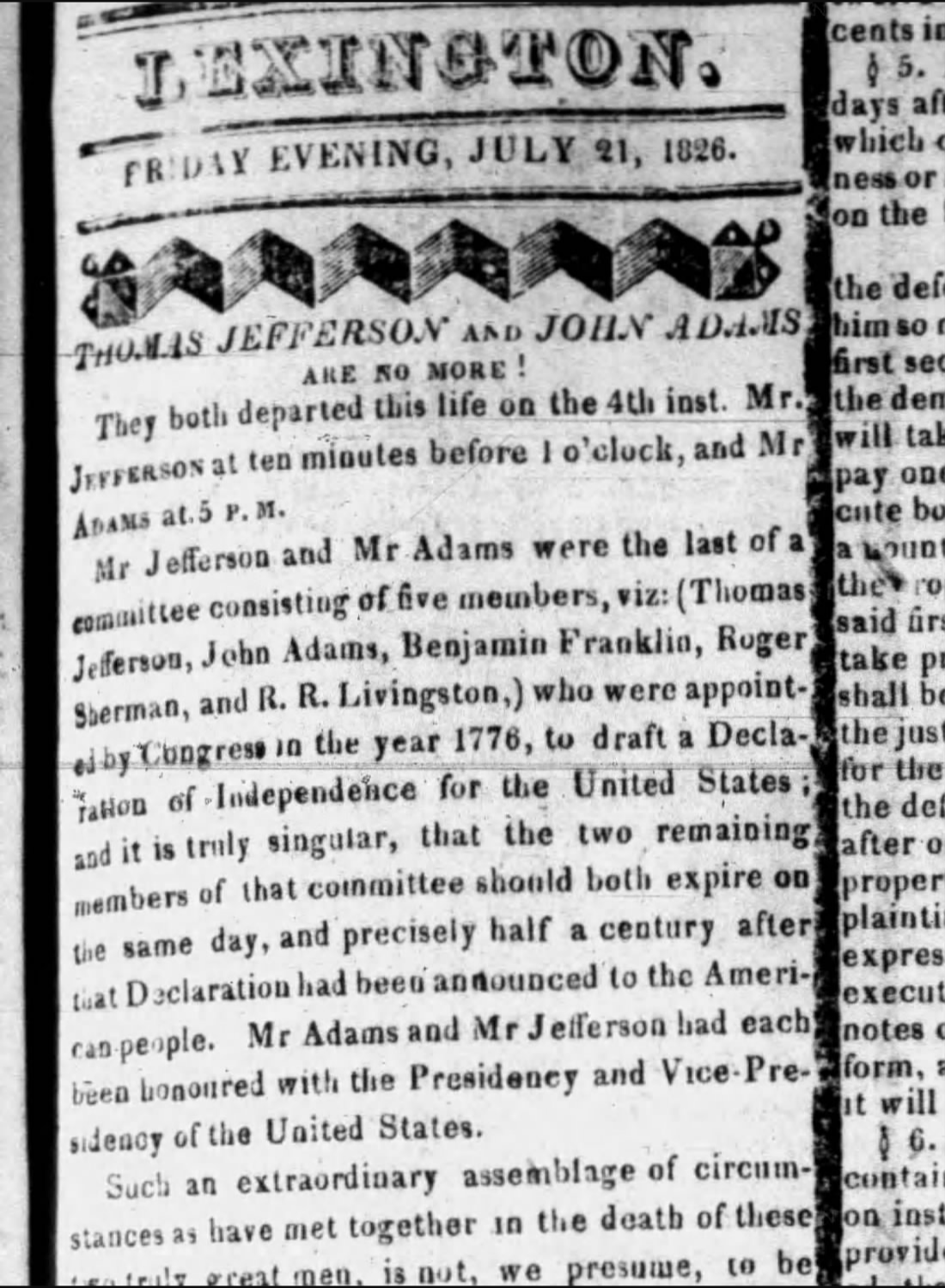
The Gazette’s editors grasped immediately how impossible the coincidence was. Jefferson and Adams, the paper noted, were the last living members of the committee of five appointed in 1776 to draft the Declaration — “and it is truly singular, that the two remaining members of that committee should both expire on the same day, and precisely half a century after that Declaration had been announced to the American people.” Such an “extraordinary assemblage of circumstances,” the editors wrote, “is not, we presume, to be found in the annals of any nation on the globe,” before reaching for a line from the Richmond Whig: in this most singular coincidence, the finger of providence is visible.
The rest of the toast list is its own time capsule of what Lexington had on its mind in 1826. Toast No. 7 went to General Lafayette — “Late our guest, now our absent friend” — barely a year after his triumphal visit to Lexington. No. 9 mourned “our brothers who fell on Raisin’s icy banks,” the Kentuckians slaughtered at the River Raisin in the War of 1812, still an open wound fourteen years later. And No. 10 raised a glass to the memory of Solomon P. Sharp, the Frankfort statesman whose assassination the previous November had ignited the “Kentucky Tragedy” — a scandal so consuming that the Gazette spent that same July printing the jailhouse confession of his killer, Jereboam Beauchamp, who was hanged in Frankfort three days after the Jubilee. Lexington’s papers that month carried the murder confession, the Jubilee toasts, and the deaths of two founders, stacked in adjacent columns.
There is even a footnote with a wink in it. A year earlier, Lexington readers were being offered subscriptions to a commemorative book — “The First Half Century of the U. States,” containing the Declaration, the Constitution, and every presidential message “From 1776 to 1826.” The half century closed on schedule. Nobody imagined its two greatest authors would close with it.
Toast No. 6 that afternoon was shorter than the rest: “The Union of the States. — May it be perpetual.” Two hundred years later, with the country’s 250th Fourth of July arriving this week, it still reads like the one toast they got entirely right.
Sources
- Kentucky Gazette, July 21, 1826, p. 1 — full text of Lexington’s Jubilee toasts
- Kentucky Gazette, July 21, 1826, p. 3 — “Thomas Jefferson and John Adams Are No More!”
- Kentucky Gazette, July 14, 1826, p. 2 — Beauchamp confession coverage (Kentucky Tragedy)
- Kentucky Gazette, Aug. 4, 1826, p. 2 — reprinted eulogies of Jefferson
- Kentucky Gazette, July 8, 1825, p. 3 — ad for “The First Half Century of the U. States”
All quotations are transcribed from the original 1825–26 Kentucky Gazette newsprint. Note: the Gazette reported Adams’s death at “5 P.M.”; historians place it near 6:20 p.m. — we quote the paper as printed.
Republishing: This is original Lexington Times reporting, licensed under Creative Commons CC BY-ND 4.0. You may republish this article, in full and unaltered, for free — including commercially — with credit to The Lexington Times and a link to the original.